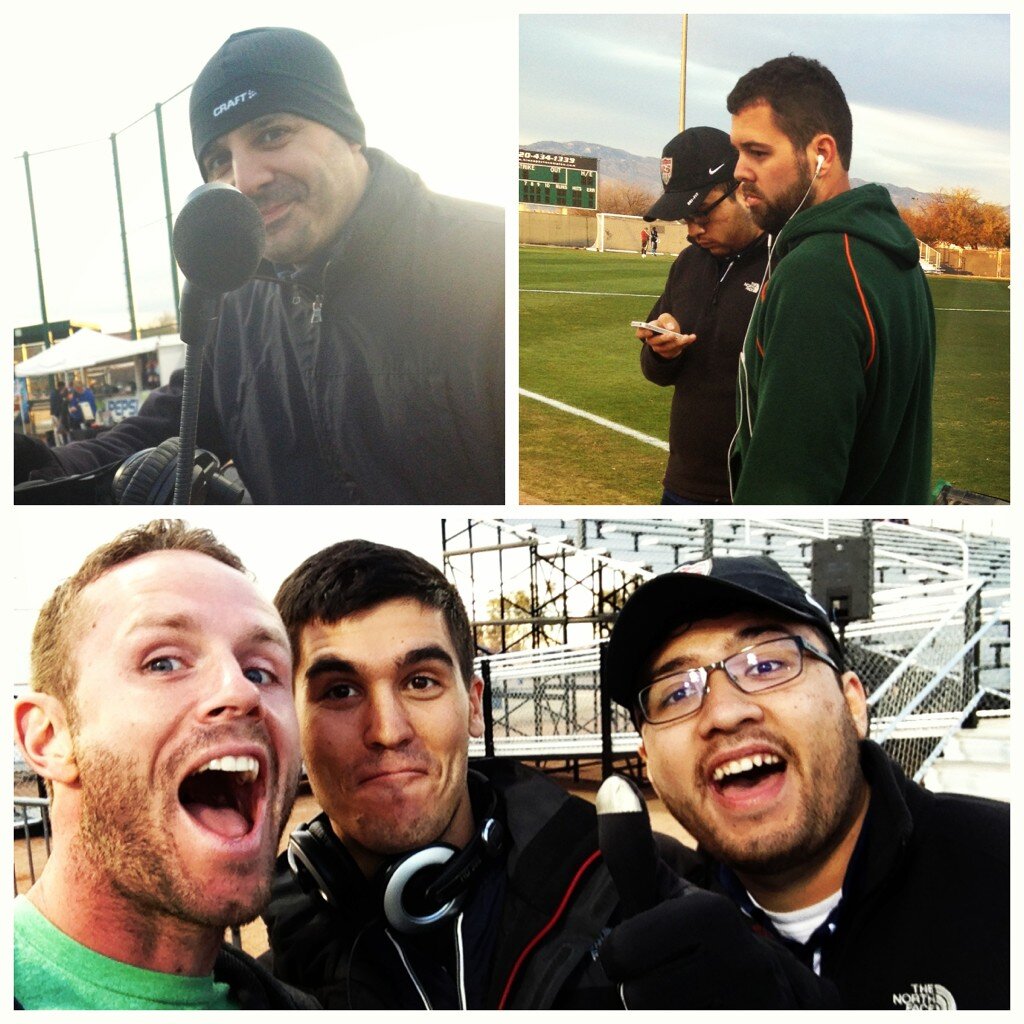
I was hoping to do some flashbacks this year to look back 10 years to
2010, when I was in my second year as the radio play-by-play
broadcaster for the Houston Dynamo. Now with sports shut down and so
much of life seemingly on hold, it seems like the right time to aim for a
series of retrospectives, looking back at some memorable or quirky
moments from my career in sports. July 31, 2010
But that call was actually a sequel. In 2010, in a game the rest of the world knew as Thierry Henry's first MLS game (that was interrupted by a pitch invader who spectacularly evaded security and then crashed into a wall), the Dynamo played the whole second half with 10 players and came from behind to score in the 90th minute and earn a 2-2 tie.
Excited, exhausted, relieved at the end of a crazy two weeks, I went off, punctuating my call with an ecstatic, "Wooo!"
Slightly more than a year later, I got to call a similar moment with Dixon's goal, but since that one was a win and I was even more excited, my punctuation went even longer and organically turned into my (in)famous, "Woohoo!"
Thierry Henry coming to MLS was a huge deal. Getting to call his
debut should have been a hugely
anticipated event. But as it happened, it was way down my priority list
that week. If you're interested in what exactly led up to that game and that call, read on ...
I was hoping to do some flashbacks this year to look back 10 years to
2010, when I was in my second year as the radio play-by-play
broadcaster for the Houston Dynamo. Now with sports shut down and so
much of life seemingly on hold, it seems like the right time to aim for a
series of retrospectives, looking back at some memorable or quirky
moments from my career in sports. July 29, 2008
Your big break. Sometimes you know it when it comes, sometimes it takes you by surprise. My first one was no surprise: I knew the stakes going in, and I knew I had to come through.
A 24-year-old in my first year as "Web coordinator" for the Houston Dynamo, I made no secret of my ambition to become a soccer broadcaster. With only low-tech college games for campus TV on my resume, I called Reserve League games into a stick mic connected to our one-camera shoot for the technical staff.
The record books show I had only called two such games when my break arrived: Our radio announcer would miss the SuperLiga semifinal to take his daughter to college.
I knew this was my opportunity to show I could do the job. Several of my bosses went to bat for me and convinced our radio partner to give me a chance, and after a few sleepless nights and a whole lot of butterflies, I was on the air!
The open was not exactly next-level. I don't think it takes an expert to tell that I was reading a written-out script as I said, "From Robertson Stadium, it's the rematch Houston fans have been waiting for, an international grudge match, as the Houston Dynamo host Mexican power, five-time Mexican champion Pachuca, in the semifinals of SuperLiga 2008. Good evening everybody, I'm Jonathan Yardley filling in" … Not the worst script in the world, but definitely sub-par delivery. But hey, it was the biggest game I had done as a professional!
Pre-game nerves, interview malfunction It was actually good that I wrote it out. I was really nervous, and to make matters worse, I'm pretty sure this was the game where I recorded a pre-game interview with Dominic Kinnear on my tape recorder, only to get back up to the press box and realize I had cut the interview off after about 5 seconds. Mortified, there was no way I was going to ask Dom for a re-do, so I anxiously waited for the players to arrive and squeezed in a few minutes with the always accommodating and insightful Craig Waibel.
So I was definitely nervous. The good thing was, I had plenty of tape on Pachuca and was really familiar with their personnel, so even if my Mexican pronunciations needed work (Marioni should be mar-ee-OH-nee, not MARE-ee-oh-nee), I had gained a lot of confidence by the time the second half and most of the game's key moments came along.
It really was a rivalry with Pachuca, because the 2007 Champions' Cup semifinal series (Pachuca won the second leg 5-2 in extra time to win 5-4 on aggregate) was incredibly intense, and that year's SuperLiga semifinal was a classic as well. There's a lot of schtick now about SuperLiga, but the tournament was a big deal for us at the time.
How'd I do?
Listening back to this, I'm proud of some of the little details I worked in, such as, "Dynamo going right to left, if you're familiar with Robertson Stadium, attacking toward El Batallon." This is a little thing, a radio detail, but it's something I still enjoy on TV - finding a unique way to indicate one end of the stadium.
I don't put much stock in prepared goal calls, so I didn't know what I would say, but you'd better believe I did not want the game to end 0-0. If you're going to earn a job or at least put together a good demo from one game, you need goals! So I was sweating a little extra (Houston in July? Yeah, it was muggy.) when it was still 0-0 at the 75-minute mark.
As Kei Kamara wins the corner, take a second to appreciate that the 2008 Dynamo had Brian Ching, Chris Wondolowski, and Kei Kamara on the same roster. Ching (82 career MLS goals) was clearly the centerpiece at the time, but Wondo (161) and Kei (128) have gone on to incredibly prolific scoring runs. Wondo, Ricardo Clark, Stuart Holden, Geoff Cameron, and Brad Davis all went to the World Cup for the US, and Pat Onstad and Dwayne De Rosario are two all-time MLS greats -- this team was stacked!
On the corner kick, note the clarity in saying how many corners the Dynamo had taken (hat tip to JP Dellacamera for instilling that in me early) and me getting the sponsor read in. Not an easy thing to remember in your first game!
Now remember how I said I don't really prepare goal calls? Yeah, I think it showed on both of these goal calls. "De Rosario .. bends it in near post, Waibel deflected, Boswell buries it!" That's all good stuff. But it needed one or two more lines to punctuate the moment before laying out.
Similarly, on the second goal, my call of the build-up was all good and technically correct, and it comes through OK: "Brian Mullan on the right, cutting toward the end line. Mullan gets there, chips it .. Corey Ashe buries it! Corey Ashe has put it away, 87th minute!" Probably could have used a little something more there, but we live and learn, right?
At least I got to make a crack about Corey's height after my partner, then Dynamo academy director and now Dash head coach James Clarkson, weighed in. I also got to give James credit for saying the last 20 minutes in the Houston heat could favor the Dynamo.
Good enough to get the job
At the end, don't mind me starting three consecutive sentences with "the Dynamo" at full time. Force of habit for a local radio broadcast, especially when you work in the team's front office. But I had gotten the job done (the team winning a big game sure didn't hurt!), and that was plenty to celebrate for one night.
That one game proved to be enough of a proving ground. By Christmas, I knew I would start 2009 as the radio voice of the Dynamo, and that was a true dream job for me. There have been more "big breaks" since, and hopefully there are still some to come, but that SuperLiga semifinal was a big deal in my career.
I was hoping to do some flashbacks this year to look back 10 years to
2010, when I was in my second year as the radio play-by-play
broadcaster for the Houston Dynamo. Now with sports shut down and so
much of life seemingly on hold, it seems like the right time to aim for a
series of retrospectives, looking back at some memorable or quirky
moments from my career in sports. June 26
I've had the fortune to have a string of memorable soccer moments on this date over the years. June alone has brought my first in-person pro soccer game (2001, Columbus), Rice winning the NCAA baseball championship (2003, Omaha), my pro debut in minor league baseball (2005, Yakima), my first game as a sideline reporter (2012, Philadelphia), and my first US women's national team broadcast (2014, East Hartford), and an England-Germany shootout (2017, from studio).
But June 26 has had more than its share of drama, and here are three with indelible memories.
2002
As a college-credit-earning intern for the MetroStars, my first game sees me spotting for broadcast legend JP Dellacamera and sees Sports Illustrated cover boy Clint Mathis returning to MLS after the US run to the World Cup quarterfinals.
In the second half, Mathis went to the halfway line and tried to check into the game, only to be sent back to the bench by the officials. I was one of the first in the building to know why: His name had not been included on the original lineup sheet!
2013
Maybe the best goal I've ever called, and it wasn't even the wildest part of the game.
First, watch Darlington Nagbe's run through the FC Dallas defense in the US Open Cup:
I didn't get every aspect of the call right, but "dancing in the box ... just blew up one entire side of the Dallas defense ... that was something special!" felt right on the money.
Now what was I doing calling that game? It's a long story. Due to my wife's job, we spent one year living in Shreveport, Louisiana, which was no picnic in terms of free-lance work. But with budgets being what they are and the Open Cup important but not a huge priority, the Portland Timbers took the chance to bring on a "local" fill-in rather than travel their regular broadcast team.
So I drove the three hours to Frisco, Texas, and set up shop in a very familiar stadium (I have called FC Dallas television broadcasts off and on since 2012). I knew Portland fans would want to hear their call rather than the audio of the Dallas webstream, so I had fun doing a radio call but also explaining to those watching that there WERE fans there, they were just on the near side of the stadium under the roof.
At any rate, the game was wild, as you can tell if you watch the whole highlights, but the Nagbe goal was just a sudden burst of brilliance that took your breath away. And surely the offensive assertiveness and aggression fans have always wanted to see more of from Nagbe, despite his high level in the midfield.
Not only was the goal, the game, and the finish great, but we had one of the great post-game quotes of all-time. The communications staff brought a microphone down to relay Caleb Porter's thoughts after the game, and he dropped the line that his players "continue to show me they have big hearts and brass balls, because they know how to get it done when the game is on the line."
I mean, really, that's a hard night to top!
2016
Three years later, I called more Timbers drama, but this time I was a seriously neutral party.
Any ESPN assignment is special for me, even to this day after 8 years working for the company at various levels. To call an MLS Game of the Week at Providence Park, one of the best atmospheres anywhere, featuring my former club, the Houston Dynamo, was just over the top.
And the game delivered! Goals, energy, back-and-forth ... and a little bit of controversy at the end, when Joe Willis was whistled for a foul that allowed Diego Valeri to convert his second penalty kick of the game for a 3-2 Portland win.
I didn't think it was a penalty kick, but partner Brian Dunseth and I ran into an ebullient Portland owner Merritt Paulson afterward, and he (of course) had no doubt!
Nothing too fancy this June 26, but we can hope for more drama in future years.
I was hoping to do some flashbacks this year to look back 10 years to
2010, when I was in my second year as the radio play-by-play
broadcaster for the Houston Dynamo. Now with sports shut down and so
much of life seemingly on hold, it seems like the right time to aim for a
series of retrospectives, looking back at some memorable or quirky
moments from my career in sports. June 2, 2010
First, the play. I posted the full game highlights to YouTube, but start with the big moment: Juan Pablo Ángel hitting a 35-yard free kick in off the post and the goalkeeper's back! to give the New York Red Bulls a dramatic win in their new soccer-specific stadium.
Incredible moment. As someone who grew up rooting for the MetroStars and now covers the Red Bulls semi-regularly, it's a special moment to have witnessed.
Except it was heartbreaking for my team, the guys I worked with and worked for, and part of a particularly maddening stretch of games.
A long time coming
Most soccer fans in New Jersey and New York know the long-running saga that predated the Red Bull era of the area's Major League Soccer club. The MetroStars (the New York/New Jersey was dropped after only 2 seasons) played in enormous, way-too-big-for-that-era-of-American-soccer Giants Stadium (I always enjoyed hearing, "Estadio de los Gigantes" on some broadcasts en español). 15,000 fans was a decent crowd for that era of MLS, but stick it in 70,000-seat Giants Stadium, and the atmosphere was pointless.
The atmosphere was so bad that I refused to attend my first professional soccer game in that stadium (more on my first pro game later this month), and it was clear very few MetroStars games would feel like an event until they had their own stadium. Over the years, the team unveiled plan after plan for a future stadium, often promising details in "60 to 90 days," only to have something fall through.
I interned for the club in 2002, right in the middle of all of this, and we literally had multiple staff meetings in which we heard, "Butts in seats. Butts in seats. Butts in seats - equals - stadium!"
Red Bull swoops
The MetroStars were my team at that point, having grown up there and worked there. But then Red Bull came in with an initial plan to ignore the history of the club. At the same time, my adopted hometown of Houston was welcoming a new team, one I could see in person and try to support into a success.
It was an easy transition to make, made easier still when the Dynamo won MLS Cup in their first two seasons in Houston and when I went to work for the club. So every Dynamo-Red Bulls game was a huge one for me, especially the 2008 and 2009 games when I got to go back to Giants Stadium with my new team, finally calling a game there in 2009.
Fancy new digs
But 2010 meant flying home to New Jersey to call a game in a soccer-specific stadium, of all things! No more 60-90 days, no more dead atmosphere. No more high-bouncing artificial turf. Major League Soccer in a vibrant atmosphere, on grass, 30 minutes away from my parents' house: This was something special.
Red Bull Arena had opened less than three months prior when we (the Dynamo) arrived in 2010 for a mid-week game. I was excited to see the place, even with its surprisingly bland gray exterior and some of the quirks of the broadcast level. I distinctly remember setting up my equipment on a folding table at the front of my designated booth, only to realize that when I stood behind it, I couldn't see large portions of the field's corners. Because the booth was on the suite level, it had the same dimensions as the suites, with none of the seats that fronted them. So I had blank rows of concrete in front of me, and I took advantage by hopping over the windowsill and calling the game while leaning back against the booth. With the table behind me, I don't think I looked at my notes much that evening!
Emotions running high
It was also an emotional time from the team's perspective. Our leader in so many ways, the talisman of soccer in Houston since the club's opening game in April 2006, was Brian Ching. Just a week earlier, he had been left off the United States roster for the upcoming World Cup, a decision which was just utterly shocking in our world. I had been brainstorming content we could do around Chingy and former Dynamo player Stu Holden going to the World Cup, and the thought of Ching not making the team never entered my mind.
Chingy faced the music - and the media - upon returning to Houston in one of the more painful media scrums I've ever witnessed. He answered the questions head-on and did his best to move forward despite one of the biggest disappointments of his career. And in his first game back, the Saturday before this trip to New Jersey, he came off the bench and scored "in HIS house, Robertson Stadium!" as I screamed on the radio call, as we took the lead on the expansion Philadelphia Union, only to give it up and lose, stunningly, in stoppage time.
The game
So emotions were running high, for the organization, the team, the players, and even this radio broadcaster.
Then, during the first half of the game against New York, Red Bulls fans chanted, "U.S. reject" at Brian Ching. As somebody who had spent the last four-plus years rooting for, meeting, working with, admiring, and supporting Chingy, it stung me, and I'm sure it angered every teammate in orange that night.
It was Chingy who tied that game in the 65th minute, breaking the offside trap to finish a pass from Bobby Boswell. And it felt just as emotional, at least for those of us in the building, as his goal at home against Philadelphia had. "He's not a Dynamo reject, he's their main man," was my reference on the broadcast.
Just like the Philadelphia game, however, there was one more twist of fate. The Red Bulls got this free kick DEEP into stoppage time, from WAY out, with no time left. You don't often shoot from that range. But Juan Pablo Ángel was the OG Designated Player, a big-name player who came over from Europe at age 31 and more than justified the pricetag. He scored double-digit goals in all four seasons with the Red Bulls and was, quite simply, a cut above.
I still didn't think he would shoot from there, or that he could beat the great Pat Onstad from that far out. But with the help of the goalpost and a friendly bounce, he did, and it's one of the great regular-season moments I've ever witnessed in MLS.
But it was heartbreaking, too. Every coin has two sides, right? Now you know my side from June 2, 2010.
I was hoping to do some flashbacks this year to look back 10 years to
2010, when I was in my second year as the radio play-by-play
broadcaster for the Houston Dynamo. Now with sports shut down and so
much of life seemingly on hold, it seems like the right time to aim for a
series of retrospectives, looking back at some memorable or quirky
moments from my career in sports. May 22, 2010
Danny Cruz always stands out for one thing: energy.
I'm just going to leave this here and let you enjoy Danny's first foray into the starting lineup.
A former hockey player who always brought that mentality to the soccer field, Danny is one of my favorite people to cover and work with, from his draft day in 2009 as a 19-year-old to his appearance on MTV's Made in 2011 (more on that here) to his years with the Philadelphia Union to the present day as an assistant coach with Louisville City. A relentlessly positive guy with an amazing attitude.
Having come to the sport a little later than most, Danny was never the most technical player at the professional level. But his speed, athleticism, and work ethic earned him a Generation adidas contract out of UNLV and led to him starting a good run of matches in both 2010 and 2011, including the Dynamo's run to the 2011 MLS Cup final.
We in the Dynamo communications office got some laughs over the years from times the wrong Danny Cruz would be listed on our team page on various sites. There was the time Soccerway listed him as Daniel Cruzeiro, a Brazilian goalkeeper, and, of course, the time the Dynamo invited a Colombian named Daniel Cruz for a trial.
I was hoping to do some flashbacks this year to look back 10 years to 2010, when I was in my second year as the radio play-by-play broadcaster for the Houston Dynamo. Now with sports shut down and so much of life seemingly on hold, it seems like the right time to aim for a series of retrospectives, looking back at some memorable or quirky moments from my career in sports.
May 8, 2010 There won't be too much more 2010 content as part of this flashback series, but it's been 10 years since I called one of my favorite sneaky-good goals, and I never get tired of excuses to watch this thing.
I mean, who scores a goal like this? Who runs onto a through ball, slides, and THEN lobs the keeper with his first touch? I don't recall this getting any momentum for Goal of the Week, and I don't think you'll see it on an MLS retrospective of best lobs, but I just think it was a special play. I know it was against Chivas USA, and I know Zach Thornton in goal was not known for his mobility, but this goal has always stuck out in my memory banks as being unusual and skillful and awesome. So please ignore the decidedly low-quality video footage and enjoy:
As you've figured out by now, It was scored by Brad Davis, one of the great assist men in MLS history, and a guy with whom I had a history. Davis was just 20, when I interned with the MetroStars in 2002, two years older than I, and although he was a hotshot rookie on the club, he was also one of the less intimidating presences for me, a college freshman. I rooted for him from the start, from the MetroStars to the Dallas Burn to the San Jose Earthquakes and then through the move to Houston, and six years later, when our paths crossed again, he was still making my life easier.
I joined the Dynamo in 2008, managing the team web site and working in the communications department, so my job included some media relations duties. Once I began traveling with the team to every game as radio broadcaster in 2009, those duties ramped up and I was often tasked with connecting reporters and players for interviews. It's a relatively simple task, but when your approach to almost any player elicits a groan and a, "What now, Yardley?" it's not always a fun one.
Brad was one of the guys who made it easy. Oh, don't get me wrong: He'd give us crap. Seeing a staffer walking toward him after practice, he'd yell out, "WHAT!?" in mock anger or walk right past with his head turned before doubling back to hear out the request. Outside the locker rooms at Robertson Stadium, if somebody flicked your ear and then scampered through the doors, it was probably Brad.
But he also said, "Yes," and, "Just have them call me," and, "Whatever you need." Words that made my life easier, all the time. An easy choice to go to when a media outlet asked who was available and I didn't want a headache by asking the same guy twice (or three times, etc.) It helped, of course, that Brad was a starter and, eventually, a durable one.
He will always be known, of course, for assists, particularly from his left-footed dead-ball service. But there were other, subtler parts to his game (did you have Brad Davis pegged for the first elastico in MLS Cup history in 2006??), and occasionally he wound up on the scoresheet for some of those as well.
As the guy who dealt with statistics in a league with second assists, I even got to play a part, which brings me to one of my favorite Brad Davis stories.
I was in the coaches' office at Robertson Stadium on a training day, probably bugging Dominic Kinnear for content for the gameday magazine and taking good-natured ribbing from everybody in the room. Talking about some recent game, I mentioned that Brad had multiple assists in the game. Dom said, "Brad, really? He just had the one, from the free kick." And I responded, "Yeah, but he got a second assist on [so-and-so's] goal. I had to call the league to make sure he got credit for it."
"Second assist, c'mon," came the reply. "What are you doing pushing more numbers for Brad, anyway? Did he put you up to it? Who cares? What in the world has he ever done for you?" (Yes, there was an expletive in there. Probably more than one, knowing Dom.)
I just kind of shrugged and said, "Hey, it's my job," which of course Dom knew perfectly well. He always made sure we remembered that the players came first and was quick to put me in my place if my actions didn't reflect that. ... But he didn't want Brad or anybody else to worry about statistics or get a big head, either. Maybe the greatest Dynamo compliment you could give was if a player was, "honest" in his work ethic.
Fortunately for me, Brad popped his head into the coaches' office a few minutes later, and I asked him about doing an interview that I needed to get crossed off my list. He quickly said, "Yeah, sure, have him give me a call," and moved on with his day. I turned to Dom and the room and said, "You asked what has he ever done for me? That, right there. Huge help."
So maybe I have a soft spot for Brad Davis, but despite his MVP nominations and his spot on the 2014 World Cup roster and his No. 3 ranking in MLS history in assists, I still felt he was underrated at times. As a technical player, as a versatile player, as a well-rounded player. Everybody focused on the dead-ball delivery, and it was incredible. But he was much more than that, and he even changed his eating and work habits mid-career to become fitter and perform at a higher level.
This goal was far from his stereotypical skillset. If you watch the play again, he and another orange jersey make the same run, chasing a well-weighted Brian Mullan ball behind the back line, and Davis actually had to out-run (or at least not lose too much ground to) Dominic Oduro, of all people, just to get to the ball first. Fortunately, Mr. Freaky Fast himself backed off and let Brad take a run at the thing.
Then the early slide is, to me, the most underrated part of the play. It seems to accelerate Davis and allow him to beat the center back (Dario Delgado, in his only year in MLS; I had to look him up) to the ball, while also leaving Thornton in no-man's land. It was timed perfectly, allowing for the scooped finish as the ball was already bouncing up.
You just don't see this play often, and it's one I always felt got lost in the shuffle but deserves a little limelight.
I was hoping to do some flashbacks this year to look back 10 years to 2010, when I was in my second year as the radio play-by-play broadcaster for the Houston Dynamo. Now with sports shut down and so much of life seemingly on hold, it seems like the right time to aim for a series of retrospectives, looking back at some memorable or quirky moments from my career in sports.
April 17, 2010
2010 was, in many ways, a lost season for the Houston Dynamo. The club missed the playoffs for the only time in its first eight years of existence (2006-13), and it led to a lot of pressure, angst, and, ultimately, changes to both the team on the field and the organization behind it.
But that doesn't mean it was all bad. There were some incredibly cool and fun moments to that season, even if they did wind up overshadowed by the frustration of it all.
So I thought I would start this series of flashbacks with one of my favorite goal calls from early in my radio days, one that survived on my demo reel for several years, even after I had transitioned to mostly TV work. Houston brought in a Jamaican midfielder during preseason named Lovel Palmer, he scored a great long-range goal in preseason, and the Dynamo pulled the trigger on a transfer, paying his club Harbour View an (of course undisclosed fee) to sign Palmer.
Lovel Palmer! That's how you do it!
His first Houston start came 10 years ago today – April 17, 2010 – in the fourth game of the season, and when he pulled the trigger from about 35 yards away in the first half, firing a shot past Zach Thornton to make it a 2-0 game, I exploded:
"Into the middle to Palmer, with a man on him. Nice turn to get around Kljestan. Palmer, gonna shoot … fires! Finds the net! What a goal! Lovel Palmer! That's how you do it! His first start, his first Dynamo goal, and boy is he pumped!"
It's one I could watch all day, because of the goal itself and because of what I knew it meant to Lovel, an emotional player who became a fan favorite with every club he represented in his career. (As an aside, I ultimately learned to pronounce his name as LUH-VELL, with an accent on both syllables, rather than the luh-VELL I used here.)
So I went back to watch and enjoy the highlights:
and I found a lot more than just Lovel's outstanding finish.
Geoff Cameron, Easter Bunny?
Geoff Cameron scored the opening goal on a feed from roommate and constant odd-couple-partner Corey Ashe, then launched into a …bunny-hop celebration? What the heck was that? Was it an Easter thing? No, this was almost 2 weeks after Easter.
I really couldn't remember, so I had to Google it, and it started to come back to me. Geoff, a Best XI selection as a center back in 2009 but returning to the Houston midfield in 2010, had done a commercial for Volkswagen involving various elaborate goal celebrations, and his was: the bunny hop. Somehow he decided to bust it out in a game (he had also used it in the 2009 Dynamo Charities Cup), and I seem to remember all of us busting out laughing at the same time.
(As an aside, look at how wide-eyed Geoff is for this commercial shoot! I don't think he's acting when he's looking around on that pedestal all uncomfortable. And who came up with this campaign, anyway? Disaster or genius?)
Dom Oduro's "shoes are hot!"
Cameron did keep the shoes on for this celebration, which cannot be said for the day's third goalscorer, Dominic Oduro. After tapping a Brad Davis feed into an empty net from about 4 yards away, Oduro "play[ed] hot-potato with his cleat," a celebration I certainly had never seen before. When asked about it later, Oduro was quoted as saying, "My shoes are hot. It's going to be hot from now on. It's a goal, and the shoes are hot."
So our communications office definitely had a "shoes are hot!" saying whenever Oduro's name came up from then on. Of course, he proceeded to score 1 goal in his next 17 games …
A Moonlight Graham moment
This highlight reel closes with the debut of 18-year-old Francisco Navas Cobo, the Dynamo's second Homegrown Player and first to appear in a game. This was a big deal for the club at the time, trying to prove to anyone and everyone that the Houston academy could and would provide opportunities no other local club could.
Of course, if you've read this far, you probably know that the Houston academy is considered one of the least successful in MLS, and Navas Cobo never made another MLS appearance, one more cautionary tale of American soccer: We're all looking for the next big thing, but the success rate is low.
End of an era
My lasting memory of this game is just bliss: a 3-0 win for the team that employed me, some great goals and entertaining celebrations to call, and a couple of debuts to boot. But in some ways, it was the last hurrah for the great Houston(/San Jose) dynasty. The Earthquakes were MLS Cup champions in 2001 and 2003, Supporters' Shield winners in 2005, then moved to Houston and won MLS Cup titles in 2006 and 2007, won the West regular season title in 2008, and tied for the West regular season title in 2009. This was a juggernaut, pushed off course by postseason misfortunes in 2008 and 2009, but still feared around the league.
The roster on April 17 had six players who had been in San Jose, with two other starters injured. Yet one week later, on a rainy night in Chicago, Cameron ruptured his PCL, and the jig was up. Having already lost Ricardo Clark and Stuart Holden in the offseason, Houston never recovered in 2010. The club finally had to go younger, and so Brian Mullan was traded closer to home during 2010, and Pat Onstad, Richard Mulrooney, Ryan Cochrane, and Craig Waibel all moved on after that season, with Eddie Robinson limping through one more campaign in 2011.
The runs to MLS Cup finals in 2011 and 2012 and the Eastern Conference final in 2013 looked very different, with only a few names (Kinnear, Ching, Davis, Clark) who had celebrated titles in San Jose colors. So, in many ways, April 17, 2010 was one final day of belief in the promise of that era. And boy, were we pumped!
Hard to believe this was 10 years ago. Although it's safe to say a LOT has changed! A special moment to call near the end of my first season as Houston Dynamo radio broadcaster (I don't sound quite ready for it, do I?), even if partner James Clarkson got a little more involved with the call than is typically kosher.
This was overtime in the 2009 MLS Cup Playoffs after Houston and Seattle had played back-to-back scoreless ties. President George H.W. Bush and 27,000+ on hand in an electric atmosphere at the since demolished Robertson Stadium.
One hell of a moment, though, and a privilege to call it:
Well, no, but it's certainly one of the most fun moments I've had the pleasure to call. The original YouTube clip is a great quick hit, but to really appreciate why I lost it and just how completely I lost it, take 5 minutes and watch/listen to the whole thing:
This was a local radio broadcast, I had been covering Dixon since he was a high school junior, and even though it was only August, it felt like the Dynamo HAD to win the game (at the time, they had not won a road game all year, and they only had three home games left).
Ultimately, the additional two points in the standings meant Houston got home-field advantage in the first round of the playoffs, helping the Dynamo reach that year's MLS Cup final in a playoff run that was a great end to my full-time tenure with the club.
This call is a bit of a lightning rod: People either absolutely love it or can barely hide their disgust. As somebody who can't stand homer announcers, I understand some of those issues. If I could do it again, would I add the 'hoo' to my original plan of a loud 'woo' to punctuate the call? Probably not. Even as a club employee, I don't find it kosher to openly cheer on the air.
But the joy of a last-minute winner, when I had basically given up on Houston winning the game, is what I, and anybody with Dynamo sympathies, was feeling at that moment. With approximately 99% of my listeners in Houston, I'll always be proud that my reaction brought so much energy, emotion, passion … and fun!
Happy five years to Dix and everybody from that Dynamo team; this always brings a slightly embarrassed smile to my face.
Had the chance to call Portland-Houston on ESPN2 on Sunday night, and in front of the always great Providence Park crowd, we had a wide-open game, a dramatic comeback, and a decisive disputed call. Check it out:
It may not always have been the prettiest game, but there was no arguing with the quality of the entertainment or the final two goals in a wildly entertaining MLS game that I got to call on Saturday night.
With the two MLS teams I know best going head-to-head, it was a special night for my first actually televised game at Red Bull Arena. I had done MSG broadcasts of road games, and I had called the Red Bulls on internet video streams, internet radio, and old-school radio, but never out-and-out TV. What a treat!
(Side note: I also realized this was my 200th MLS game seen in person - 183 regular season, 17 playoffs. Not bad!)
Besides the seven goals and some of the close calls, there was the additional storyline of the Red Bulls losing three players during the game with hamstring injuries, all while trying to get their first win of the season. Houston set an MLS record for most goals scored in the first three games of the season (11), but still blew a pair of second-half leads!
An incredible night, and Shep Messing, Tina Cervasio, and I had a great time calling the game. Here's the quick version:
Checking out BBVA Compass Stadium in progress.(photo by Nigel Brooks)
Brian Ching was one of my favorite players before the San Jose Earthquakes moved to Houston and before I began working for the Dynamo, so instead of writing a long, emotional column about his retirement, I'm going to tell a few anecdotes and post some videos paying tribute to a guy for whom I have a tremendous amount of respect.
I think my favorite Brian Ching story comes from my first year working for the Dynamo in 2008. I was new to the team and the players, and Brian was a very intimidating presence to me. Before one game, I was assigned to tell Brian about a pre-game interview with a television partner and coordinate it. In this case, that meant getting him from the locker room and walking him across the field to the interview location. So I made some awkward small chat as we walked, me in khakis and dress shoes, he in shorts and flip-flops. When we got to the camera, a starter from the opposing team (a guy who had been in the league for a couple of years) was still doing his interview, so Brian sat on the Houston bench to wait. After a few minutes of looking around and watching the interview, he turned to me and said, "Who is that?" I responded with the player's name. He looked at me with a blank expression. We were about to play this team in maybe 90 minutes, and he did not know one of their starting midfielders!
It's not that he was unprepared or disrespectful, but something about his intense focus on his role, his game, and his team. Ching scored that night, and Houston won the game.
I also love reminding people that Ching was, to my knowledge, the first North American athlete to be fined for using Twitter. Ching is not usually a particularly outspoken quote or a lightning rod for controversy, but he was the first. It happened in 2009, while he was with the U.S. national team for the Gold Cup, and Seattle tied the game against Houston on a controversial goal-line call. Ching Tweeted "ref is a cheat," I think referring to the far-side linesman who signaled for the goal, and later paid the price.
Watching Ching deal with his exclusion from the 2010 World Cup squad was one of the hardest things I've ever seen somebody go through, but he handled it amazingly well. It made me proud every time he answered a question about it, candidly admitting his disappointment, and every time he scored or made a big play that summer, sticking it to opposing fans who needled him with the "U.S. reject" chant.
I respect and like Ching, on the field and off, and watching him lift the Eastern Conference championship trophy as Houston's captain in 2011 was one of my favorite moments with the team. I'll miss watching him play, but I'm glad he still plans to be a part of MLS, and I hope I get the chance to work with him in the future.
In addition to the great work from HoustonDynamo.com and the strong interview by CSN Houston's Sebastian Salazar looking back at his career, here are two additional videos worth watching, one from MLSsoccer.com and one from yours truly. Thanks, Brian.
Late heroics helped San Jose to the 2012 Supporters' Shield, but two late goals were not enough in their playoff defeat.
I have the privilege of filling in on the Comcast SportsNet New England broadcast of Saturday's New England Revolution vs. Houston Dynamo game, so I've been preparing as much as possible. That involves watching both teams - recent games and past highlights - and studying the numbers.
One number that jumped out as a positive for both teams was their performances in the last 15 minutes of games; both New England and Houston have scored 13 goals this year from minutes 76-90. The league's stats and standings release, which comes out after every gameday, includes two separate tables detailing goals scored and allowed, by each team, broken down by 15-minute intervals. What is not directly released (and often not publicized), however, is teams' goal differential during different segments of the game. That, to me, is the more important statistic. After all, what good is scoring a bunch of late goals if you're allowing even more?
Team
Last 15 mins
Overall
GF
GA
GD
GD
Portland
14
4
+10
+14
Houston
13
5
+8
+1
Real Salt Lake
19
12
+7
+14
Kansas City
10
5
+5
+15
Seattle
7
2
+5
+10
New England
13
9
+4
+8
Philadelphia
11
7
+4
-2
San Jose
10
6
+4
-10
New York
16
14
+2
+11
Colorado
7
5
+2
+6
Vancouver
10
9
+1
+4
FC Dallas
14
14
E
-2
Chicago
9
10
-1
-7
Montreal
9
15
-6
+4
LA Galaxy
12
18
-6
+10
Columbus
6
13
-7
-3
Toronto FC
6
14
-8
-19
D.C. United
3
11
-8
-29
Chivas USA
6
22
-16
-25
So I set out to see how Houston and New England ranked within MLS as late-game success stories, and the numbers I found across the league surprised me in a few ways. Check out the table at right, which lists teams' goals for and goals against in the final 15 minutes, as well as how that goal differential compares to their overall goal differential.
I am not going to try to identify all general trends in this data; for one thing, it's too small a sample size. But I see some really interesting notes about different teams:
Houston, Philadelphia, San Jose, and Dallas are the only teams whose goal differentials in the final 15 minutes are BETTER than their overall GD.
Incredible efforts by Seattle (2 goals allowed) and Portland (4) in terms of late defense. It's very hard to keep that up over a whole season, and since I think of defense as tending to be more consistent than offense, I think it bodes well for their postseason chances. Obviously, Houston, KC, and Colorado (5) are right behind.
I would not have guessed that the LA Galaxy would be -6 in the final 15 minutes and have the league's 2nd-worst late defense, better only than Chivas USA. Yet they still have that +10 overall goal differential.
Seeing Seattle, Real Salt Lake, Portland, and Kansas City all in the top five in late goal differential just seems to make sense, since all four feel like quality MLS Cup contenders.
The identical -6 late goal differentials of Montreal and LA make me a little less confident on their chances for playoff success.
Interesting to note the contrast in late-game fortune for strugglers D.C. United and Chivas USA. D.C. is -21 in the first 75' of a game (presumably, the result in D.C. games is usually decided before the last 15'), while Chivas is only -9 in the first 75' and tends to get punished late.
The most interesting question this raises to me is: Are the final 15 minutes a better or worse indicator of how good a team is? In some respects, you should put more stock in performance over the first 75 minutes than the last 15, because it's a larger sample size. But at the same time, the ability to pull out a late result and come through "in the clutch," to use a sports cliche, is one that is highly valued.
In MLS circles, one has to think of last year's San Jose Earthquakes, who scored 20 goals from the 76th minute on en route to the Supporters' Shield title, which was widely considered an over-achievement. They promptly fell in the playoffs, going a damning -3 in the first 75' of games in their two-leg playoff series, while only compensating with 2 goals in the final 15'.
What this means for New England vs. Houston
Is Houston's -7 goal differential in the first 75 minutes of games this year a sign that the Dynamo are just not that good? Perhaps they will regress to the mean, allow some late goals, and fail to reach the postseason. Or is their +8 goal differential in the final 15 minutes an indicator that they save their best for when it counts the most, as seen in their recent playoff runs? Perhaps they will make another deep run. Or can the difference be explained by the suffocating Houston heat, which wears down opponents and allows Houston to pounce late in home games? That actually is not the case, as Houston is +9 at home and -8 on the road, but in the final 15 minutes, the Dynamo are +4 both at home (6-2) and on the road (7-3).
New England, meanwhile, is a more conventional +4 at home (8-4) and even on the road (5-5), but it should be noted that the Revolution began the year allowing six late goals, yet they are now +10 in the final 15 minutes since losing at home to Real Salt Lake on May 8 (both RSL goals came in the final 15). The goal that turned the tide was Juan Agudelo's 84th-minute tally to clinch a 2-0 win at Houston on May 18. The Dynamo returned the favor with a 79th-minute game-winner from Adam Moffat at New England on July 13, though Moffat is no longer with the club. So maybe we're in for yet another late goal on Saturday night!
This list creates more questions than answers, which is part of the fun. But my larger point is that I hope media and fans factor in late goals scored AND allowed when considering a team's late fortunes.
My trip to Salt Lake City to call Saturday's RSL-Houston game felt like a bit of a whirlwind -- mostly because I flew out on a red-eye the night after the game. But I managed to find time to snap a few photos of the Salt Lake City scenery and the pre-broadcast preparation. Here's a look:
View from the plane of the Great Salt Lake.
I walked by the Salt Lake City and County Building on Saturday morning.
I also happened by the Matheson Courthouse.
My first time entering Rio Tinto Stadium through the main entrance.
One of the league's most dramatic backdrops ...
... and the broadcast truck preparing to highlight those Wasatch Mountains.
With Sebastian and Eddie ... can't wear an orange tie EVERY game!
Jason Kreis is hoping to avoid a third consecutive stoppage-time defeat against Houston.
I’m back on the MLS airwaves this weekend with a chance to step in for Glenn Davis and call Saturday’s Real Salt Lake-Houston game on Comcast Sportsnet Plus in Houston. I’m really excited for just about every aspect of this broadcast: working with Eddie Robinson and the Comcast crew, calling a game with the dramatic backdrop provided by Rio Tinto Stadium, and of course the matchup itself.
It’s not a rivalry game in the traditional sense (no geographic ties or playoff matchups), but I’ve been at nine of the last 10 games between these teams, and they’ve all been intense. The reason, to me, is a simple one: Even among MLS head coaches, who have to be competitive by nature, head coaches Dominic Kinnear and Jason Kreis stand out as two of the most intensely competitive personalities in American soccer. Their teams are skilled, but physical, and games between these two have always been closely contested – out of 16 head-to-head contests, 14 have been decided by one goal or less.
Here are some early thoughts on the game:
Despite Houston’s dominance in the all-time series (8-3-5 all-time, 6-1-4 since August 2007), Salt Lake has to be considered the favorite on Saturday. RSL is tied for the Supporters’ Shield lead (38 points from 23 games), leads the league in goals per game (1.65), and has the league’s goals against average leader in Nick Rimando (0.89). More importantly, the game is in Utah, where RSL has a 3-1-4 all-time edge. Three of the last four games between the teams in Utah have finished 0-0 (2008, 2009, 2011), and the other was a resounding RSL win. For an idea of Houston’s perspective, the 2009 game was the very rare instance I can recall of Kinnear playing for a draw almost from the start (started in a 4-5-1 formation with Kei Kamara at right midfield).
On the other hand, Salt Lake might be vulnerable at the moment. It will be RSL’s third game in eight days, and if media quotes are to be believed, Wednesday’s Open Cup semifinal against Portland is considered a higher priority. Salt Lake's last two home games have seen them collect just one point, with a player ejected each time. And after an 11-game unbeaten run in all competitions, RSL is winless in its last three games, including two gutting stoppage-time losses.
Hmm, stoppage-time losses. Sounds familiar. Houston has beaten Salt Lake in their last two head-to-head meetings on goals in the 93rd and 94th minutes, respectively. After last year's Colin Clark PK, Jason Kreis had that classic, stone-faced, I-can't-believe-that-just-happened look, and we saw it again when RSL lost to New York on Saturday. But both teams actually have a flair for the dramatic. In the final 15 minutes of games this year, RSL leads MLS with 15 goals scored, but has allowed 9 goals (+6 goal differential). Houston is second-best in MLS with only 3 goals allowed and has scored 10 of its own (+7 goal differential). So we could see some dramatics on Saturday night. After all, the last time I called a Houston-Real Salt Lake game, this happened:
With the Major League Soccer season kicking off on Saturday, I was invited to participate in a Google Hangout with two of my favorite soccer-talkers, Darrell Lovell (MLSsoccer.com beat writer for the Houston Dynamo) and Simon Borg (MLSsoccer.com editor). I can BS with these guys all day long, but we held it to 37 minutes in this video hosted on the Houston Dynamo website on Wednesday.
I may not know when/where/for whom I will be working during this season, but I can still talk a pretty good game. Here's a look back at our chat:
My 2013 broadcasting season is underway, as I'm at the Desert Friendlies in Tucson, Arizona, working on the MLSsoccer.com online broadcasts! After calling Houston-Colorado tonight, I'll work a game Friday, two games Saturday, and wrap up the trip with Seattle-Portland on Tuesday morning.
Game highlight package:
The game production may seem simple compared to a regular-season broadcast, but it takes a lot of people and effort to put together our show. You can see a few of them at the right -- I promise they don't always look like that. Luckily, most of these guys worked three games on Tuesday, so they felt like a single game was easy pickings.
My broadcast partner, MLS 'Armchair Analyst' Matt Doyle, conducted interviews with players and coaches from Houston and San Jose during the day, so I tagged along and tried to pick up whatever behind-the-scenes information I could. We got an early tip on an injury to Houston goalkeeper Tyler Deric and got a better idea of San Jose's roster situation, while also hearing MLS veterans talk about some of the league's top players. Hearing the near-universal praise for Landon Donovan is always really impressive - he is pretty much universally accepted as the best player in MLS history, and with good reason.
On to the game itself. Our hotel managed to totally screw up all my printing options, so my carefully prepared notes on players from both teams - especially important in a pre-season game with many non-roster players - never got printed. To make matters worse, when I got to the stadium, I was told the internet line we were using to stream the games had been cut off. Not exactly a perfect start!
But the internet situation got cleared up, I found time to at least write down lineups and numbers, and we were off. It's a bit weird calling a game from a really low position - on a platform maybe 35 yards off one end line - while the camera angle the viewers are seeing is the preferred high-middle shot. But we had a lot of fun with the show, sharing some trivia and banter and reacting to Twitter comments in addition to calling the game and talking lineups and trialists. Four more games to come this week from Tucson!
The MLS preseason is inevitably a blur of players coming and going as teams try to fill out their rosters. Here is an attempt to keep track of who's under contract, who's in camp with whom, and which teams are keeping spots open for the summer.
Information is unofficial, acquired to the best of my ability via team and media reports.
Eastern Conference:
Chicago Fire (17-11-6, 4th East) -- Frank Klopas
Signed: 26 / Open: 4
2013 Newcomers: MF Joel Lindpere (trade, New York), FW Maicon Santos (re-entry, D.C. United), MF Jeff Larentowicz (trade, Colorado), MF Brendan King (1990, Bray Wanderers - Ireland), MF Dilly Duka (trade, Columbus), FW Quincy Amarikwa (trade, Chicago), MF Yazid Atouba (draft, 1993, Cameroon),
Draft: Atouba, LB John Gallagher (1990, Penn State), GK James Belshaw (1990, Duke), DF Caleb Konstanski (1991, Indiana)
Trial: GK Alec Kann (1990, Charleston Battery), FW Colin Rolfe (1990, Houston), DF Pascal Chimbonda (1979, Guadeloupe), DF Leo Lelis (Fluminense, Brazil)
Other: GK Jay Nolly (1982, Vancouver) - rights acquired, unsigned
My apologies for the lack of posts - I've doing some mix of working and procrastinating, and I'll leave you to determine which has won out. I've also been watching as much of the MLS Cup playoffs as possible and have enjoyed the ridiculous drama, even though I'm often watching on delay and could simply open a new tab to find out who won.
Rather than a whole, long, drawn-out, "I told you so," I'll just point out that one team will have a huge competitive advantage in the MLS Cup final (home field) based on a difference of five points or fewer over its opponent, one which may have played a more difficult regular-season schedule. As long as that schedule is unbalanced and the final is a single game, I believe it must be played at a neutral site, purely for competitive reasons.
But I digress.
Today, just for fun, I'm picking a Best 11 from the first 10 playoff games of 2012. Why? Because I want to inspire an official all-tournament team for the MLS Cup Playoffs. It's gotta start somewhere, right? Unlike most Best 11s, I will use the Arabic numeral 11, rather than the Roman numeral XI. And unlike most Best 11s, I will choose a starting lineup with players in their actual positions. Groundbreaking, I know. OK, here we go:
MLS Cup Playoffs Best 11 (+7) (conference semifinals and knockout round games only)
GK - Nick Rimando, Real Salt Lake - I'm actually not a huge Rimando fan, because I prefer a 6-foot-plus goalkeeper who can control the penalty area, but a shutout with a broken nose and that exceptional save on Brad Evans early in the second half Thursday night make him a must-choose. Honorable mention to Michael Gspurning and Tally Hall.
RB - Robbie Russell, D.C. United - I know he only played one game, but it was a great game, and all the other right backs who played both games did very little. Seriously, count them. Sarkodie, Myers, Franklin, Beitashour, Lade, Johansson, Beltran. I really like some of those players, but Russell's 90 minutes stood out more than their 180.
CB - Omar Gonzalez, LA Galaxy - This guy is a giant. Not only that, he's really good. If LA wins the title, people will complain about how low a seed they were, but LA was 7-2-3 during the regular season when Gonzalez started, and he was excellent against Wondo and Lenhart. How many center backs were secretly pleased when he elbowed Lenhart in the face?
CB - Jeff Parke, Seattle Sounders - The Sounders didn't allow a goal in 180 minutes against a very good team, and while some of that is on RSL's pathetic execution in the final third (they finished the year being shut out in their last five games), Seattle's defense has to get credit, and Parke's the man for that. Honorable, honorable mention to Bobby Boswell.
LB - Seth Sinovic, Sporting KC - I know, I know, you think I'm picking a defender just because he scored a goal, but really I'm going with Sinovic because Boniek Garcia was relatively quiet in both legs for Houston, none of the Dynamo goals came on Sinovic's side, AND he was the only KC player to find the net. With a diving header. Hard to beat. Honorable mention to Corey Ashe, who was outstanding in the knockout round against Chicago.
RM - Landon Donovan, LA Galaxy - This is tricky, because he did play forward in this series, but I thought this was the best spot for him. He silenced a lot of doubts with a two-assist performance on Wednesday, and I never pick against Landon in the playoffs.
CM - Osvaldo Alonso, Seattle Sounders - This guy works his butt off, and even though it seemed like he was fouling Javier Morales every five minutes in last night's game, the Sounders rarely got pulled out of position against RSL's very tough midfield, and he deserves a lot of the credit. Honorable mention to his partner in crime, Brad Evans.
CM - Ricardo Clark, Houston Dynamo - He has been everywhere in the Dynamo's three playoff games, sliding to break up a play and set up the game-winning goal against Chicago before frustrating Roger Espinoza in Houston last week. His range has reminded everybody of why Dom Kinnear's 4-4-2 was so successful from 2005-09.
LM - Mike Magee, LA Galaxy - All he does is score big playoff goals. And occasionally play goalkeeper really well. But really, it's the clinical playoff goals that put him here. Honorable mention to Nick DeLeon.
FW - Robbie Keane, LA Galaxy - Duh. I enjoy disagreeing with statements made by Bruce Arena (he wants you to disagree with most of them), but when he praises Keane as the best player in the league this year, you can't really argue. Especially when Thierry Henry won't take a last-minute free kick with his team down a goal in a playoff series.
FW - Will Bruin, Houston Dynamo - Clinical, clinical finishes. Three of them. Two of which are not the type usually scored by Houston forward. Easy choice here. Honorable mention to his wingman, Calen Carr.
Bench (these players were actually used as replacements in the postseason)
GK - Joe Willis, D.C. United - If he can come off the bench and save a PK, it's good enough for me. Might be better than Bill Hamid right now anyway. He's definitely more composed.
CB - Andre Hainault, Houston Dynamo - He had really struggled in the second half of the year (and he was on the field for Honduras 8-1 Canada), but he looked confident and competent when called upon against KC.
CB - Tommy Meyer, LA Galaxy - I'm cheating a bit here, but the guy had only started 4 MLS games since May, so I don't consider him a full-time starter.
DF/MF - Lewis Neal, D.C. United - Surprise under-the-radar pick-up who helped Orlando City to USL title last year. Makes you want to promote them straight to MLS, doesn't it?
MF - Oriol Rosell, Sporting KC - He got to play with lower-than-usual pressure because of the situation, but I was impressed with his composure and ability to keep things simple from that deep-lying midfield slot.
MF - Mario Martinez, Seattle Sounders - Yes, I'm picking him just because of his one, series-winning shot. It was that good.
FW - Alan Gordon, San Jose Earthquakes - Goonies never say die. Even when they sprain an ankle.
Houston could play the second leg of a quarterfinal at BBVA Compass Stadium, depending on goal differential
The group stage of the CONCACAF Champions League - contested for the first time in eight groups of three - is down to one remaining round of matches, to be played October 23-25. Three teams have clinched their spots in the quarterfinals, but even those three teams need to be on their game next month. Here's why.
One of the changes to the competition is that matchups in the quarterfinals (and beyond) are now determined by performance in the group stage, rather than by random draw. This is an underrated move by CONCACAF, in my opinion. Yes, the teams are being compared against unequal opponents; is it really fair to reward teams that go 4-0 against a group that included a Caribbean or weak Central American opponent? But the move is worth that question because (a) it legitimizes a competition that sometimes seemed to be fixed to get at least one American team to the semifinals and (b) it makes every minute of the group stage count.
Seeding in the knockout round is very important, because the higher seed gets the second leg at home, usually a big advantage. This is far from the only reason Mexican clubs have dominated American ones in head-to-head competition, but the second leg has been in Mexico more often than not. This time, they'll have to earn it.
So here's how the race for home-field advantage in the elimination round shapes up. Projected seeds are how I think the teams will finish, not their current spot:
Proj Seed
Team
Record
GD
Last Game
(Almost) clinched
1
Santos Laguna
3-0
+11
10/24 vs. Toronto
OR
Toronto FC
2-1
+5
10/24 at Santos Laguna
2
Monterrey
3-0
+9
10/23 at Chorrillo
3
Seattle Sounders
3-0
+5
10/24 vs. Marathon
4
LA Galaxy
2-0-1
+7
10/25 at Metapan
Battling it out
5
Houston Dynamo
2-0-1
+6
10/23 vs. Olimpia
OR
Olimpia
1-1-1
+2
10/23 at Houston
6
Real Salt Lake
2-1
+2
10/23 vs. Herediano
OR
Herediano
3-0
+3
10/23 at Real Salt Lake
7
Tigres
1-0-2
+4
10/24 vs. Alajuelense
OR
Alajuelense
2-0-1
+4
10/24 at Tigres
8
Chivas
1-1-1
+3
10/25 vs. Xelaju
OR
Xelaju
2-0-1
+2
10/25 at Chivas
Head-to-head matchups will determine the final five spots (CONCACAF may have a history of corruption, but the people running do not miss a chance for drama, pairing two powers in the final match of each group), but you can see where this is going. If the home teams prevail with the results they need, we'll get the Mexican/U.S. quarterfinals, but the matchups would play out to something like this:
1. Santos Laguna vs. 8 Chivas Guadalajara
2. Monterrey vs. 7 Tigres
3. Seattle Sounders vs. 6 Real Salt Lake
4. LA Galaxy vs. 5 Houston Dynamo
Of course, that's taking a lot for granted. Five teams still need to take care of business just to advance. But the point is that they need to focus not just on doing enough to advance; they need to be worried about their quarterfinal seed. Santos cannot afford to tie Toronto at home; a win would secure them the top seed. Seattle cannot afford to be on cruise control against Marathon; they have an outside chance of catching Monterrey for the all-important No. 2 seed, which could give them a home game in the semifinals.
Real Salt Lake, Tigres, and Chivas will all be trying just to get the win that will send them to the quarterfinals (RSL needs to win 1-0 or by multiple goals), and Houston needs just a tie at home against Olimpia. Given its precarious MLS playoff position, the Dynamo will probably put out a mixed squad, but winning and tacking on a few goals should still be a priority in an attempt to wrest the second leg of a potential quarterfinal matchup away from recent rival LA. After all, Houston's last two playoff outings have ended at The Home Depot Center.
The new format of the Champions League has its positives and negatives, but there is something to play for in all eight of the final matches, and we could be in store for the most storied quarterfinalists in the tournament's short history.