Showing posts with label college baseball. Show all posts

30 May 2024

Linear College Baseball Debut!

I'm not going to lie: I was as excited to do this game as any I've called in the last year and a half. I emailed maybe 100 people who have been instrumental in my baseball broadcasting career to let them know that I was *finally* going to call a college baseball game on linear TV.

That it wound up being a game with no implications in the standings or for either team's postseason chances didn't change that at all. That it wound up being ended early due to the 10-run rule didn't phase me at all. This was high-level college baseball, and my partner and I told the stories and put a good call on it! And I even got to use the home run call suggested by my children while we were riding the New York City subway.

Mission accomplished, as far as I was concerned, and cross your fingers with me that there is more to come. In the mean time, check out the highlights from Clemson vs Boston College:


06 May 2024

Back to College Baseball! Seton Hall-UConn highlights

I'm thrilled to have college baseball back on my schedule 2024. I started my broadcasting career as a college freshman back in 2002, with college baseball the central focus for all four years at Rice University. It is one of the sports I follow closely purely out of passion and interest, even if I'm not working in it ... but I much prefer to be working!

I was fortunate this year to schedule my first televised college baseball game for the ESPN family of networks at the end of this regular season, and I picked up a Big East game in early May as part of my preparation. Conference leader UConn, looking for a fourth straight regular season title, and host Seton Hall, trying to move up the standings, both needed to win this series in a big way, and after UConn rallied to win Friday's opener, I called a tense pitchers' duel with a dramatic finish on Saturday afternoon in Jersey.

Here are the big plays in the game, courtesy of the teams' respective Twitter accounts!


That's Andrew Bianco, a defensive replacement, with the game-winning hit in the bottom of the 9th to give Seton Hall a MUCH-needed 2-1 win. UConn, however, rebounded in the nightcap of a doubleheader to take the series and hold a 1-game lead atop the conference with two weekends remaining in the regular season. Seton Hall is 4 games out of the final Big East tournament spot with only 6 games left.

My next action is on Saturday, May 18, calling top-5 club Clemson against Boston College in their regular season finale on ACC Network.

23 April 2018

Baseball: You always see something new!

I try to avoid cliches, at least to some extent, in my sports broadcasting -- we aim for originality whenever possible!

But many of them exist for a reason, and one is something long-time baseball fans like myself rely on: Every time you go to a baseball game, you see something you've never seen before.

Even in a game with as many different combinations of plays, lineups, personnel, etc. as baseball has, this seems impossible. Surely there are fairly straightforward contests that veterans of hundreds of games can describe as routine.

But last week, for me at least, this saying rang absolutely true. I went to three games - one at the new Yankee Stadium and two college contests at St. John's - and saw something new each time. I've probably been to 800 baseball games, broadcasted almost 500, and I had no precedents to refer to.

Monday - New Yankee Stadium, Yankees vs. Marlins
I took advantage of a $5 ticket offer to make it to my first Major League Baseball game of the year, along with a long-time friend in from out of town.

The Yankees rolled 12-1 in cold, windy weather, but the play that drew my attention came in the 6th. With a runner on second, the Yankees' Brett Gardner lined a ball straight back up the middle, but it hit the second-base umpire, who was standing on the infield grass. Since the ball never left the infield, Miguel Andújar, who had been on second, had to stop at third base rather than score.
I was initially surprised when Andújar returned to second base, because in many cases, a ball that hits the umpire is considered the same as a bad bounce - it's just luck, and you play on.

But in this case, the umpires ruled the ball dead as soon as it struck the umpire, which means any runner goes back to his original base unless it's a force situation. The hitter, Gardner, is awarded a single (as when a batted ball strikes a runner in fair territory), and nothing else happens. Heck, MLB's play-by-play account lists "Gardner singled on a ground ball to second baseman Starlin Castro." Try telling the umpire that was a ground ball!

The reason for the different status of the umpire in this case is that the ball had not passed any fielders (the pitcher does not count for these purposes) before it hit him. Had the ball gone past an infielder, such as the first baseman, and then hit an umpire, the ball would still be in play.

I had never seen that one before!

Friday - Jack Kaiser Stadium, St. John's vs. Georgetown
I went out to Queens on Friday to watch the opening game of the St. John's-Georgetown series, knowing I was scheduled to call Sunday's game and could use some additional information and any first-hand stories I might be able to pick up. Despite getting a late start and a few public transportation issues, I arrived during the top of the first.

I did not have to wait long for something to catch my eye, however. With St. John's batting in the bottom of the 1st, Georgetown's pitcher took his signs not from the catcher, not from a coach, but from six enormous posterboards being hoisted on the top step of the Hoya dugout by players. Similar to the cards employed by college football offenses in just about every part of the country, each board had several logos and would be rotated to indicate different things.

My focus rarely left those boards whenever St. John's was batting during the rest of the game. I couldn't turn away! I have never see anything close to this in baseball before. Large boards have often been used to indicate defensive alignments, but pitch-calling has almost always gone coach-catcher-pitcher. Many teams now use wristbands (again, borrowed from football), and the SEC (football!!) even allows the coaches to talk directly to their catchers via wireless receivers.

Georgetown, on a slightly different budget than an SEC program, has been doing this all season:
The process seemed to be that, almost immediately after the previous pitch, Georgetown pitching coach Eric Niesen would walk one way down the dugout behind the group of six players holding the cards. With a clipboard over his mouth, he would verbally tell them what pitch to call. They would then rotate the boards accordingly and hold them up once their pitcher looked into the dugout from atop the mound. No shake-offs - just follow the signs. And to Georgetown's credit, I did not see a cross-up all day.

I later asked for a little more detail and found out that the idea came to the Georgetown staff, led by Pete Wilk, through a coaching friend, and that all position players, not just the pitcher and catcher, read the boards to know what pitch is being called. Without needing to go through multiple series of signals, pitchers can work more quickly and keep defenders on their toes. Maybe Major League Baseball, trying to speed up its games, should take a look!

Sunday - Jack Kaiser Stadium, St. John's vs. Georgetown
It was back to Queens on Sunday for work, calling the final game of the Big East series for a St. John's ESPN3 production. It's the best college baseball in the area, and I love the chance to stay close to the college game. St. John's has had very good teams in the five years I've been calling them, including this year's squad, currently third in NCAA Division I in ERA and riding a 12-game winning streak.

No. 12, on Sunday, was one of the most difficult, as the Red Storm and Hoyas reached the 10th tied 1-1. After a one-out walk, St. John's leadoff hitter John Valente doubled off the left-field wall to extend his on-base streak to 51 consecutive games, dating back to last season. Impressive, to be sure, but it lags behind the presumed NCAA record of 93 consecutive games, set by Kansas State's Nick Martini from 2009-11. Valente, a redshirt senior, won't have enough games to even try to catch it.

But that's not the *new* thing I saw. With the winning run now 90 feet away, St. John's called for a safety squeeze. The bunt barely got in front of the plate, and Georgetown catcher Ryan P. Davis (an accomplished ballet dancer in high school, probably something I've never come across before in reading up on a player!) grabbed the ball immediately. Davis held the ball in his glove with his throwing hand and advanced up the third-base line toward the runner, Josh Greene. With few other options, Greene tried to spin away from the tag, forcing Davis to extend his glove hand to make the tag. Greene whirled toward foul territory, appeared to make contact with the glove, but recovered to dive for home plate.

The umpire, to everyone's astonishment, called Greene safe! St. John's celebrated a weekend sweep, while Georgetown argued on multiple grounds. Davis thought he had made the tag, but it was clear that he left the ball in his throwing hand while tagging Greene with only his glove. So the umpire got that part correct. The consensus was, however, among fans wearing both colors, that Greene was decidedly out of the baseline and should have been called out.

Regardless of the outcome, that's an ending I've never seen before! One of the many reasons baseball remains among my passions.

01 May 2015

How is it already the end of April? What I've been up to lately and other pictures ...

May 1, really? Came way too fast for me.

The good news is that I've kept fairly busy. The Big East Digital Network and St. John's have given me the opportunity to dive back into my first broadcasting love, college baseball, while I usually seem to find enough Major League Soccer-related work to keep me going.

On the baseball side of things, I'm up to 31 different stadiums in which I've seen college games after I saw Villanova Ballpark for the first time with Bob Hirschfield back on April 19 in a really interesting Villanova-Xavier game that went down to the wire.

We were back at St. John's, of course, the following weekend, and I never tire of trading stories with Bob, the former head coach at NYIT and a player on the 1968 St. John's team that went to the College World Series. I've done enough games at Kaiser Stadium now that the crew running the broadcast features a bunch of friendly faces every time I go, and it's great to develop that kind of routine and comfort level on a show.

Back in soccer, I've done radio calls for two New York Red Bulls games, and I got to cover the International Champions Cup press conference on Tuesday. It was as good an excuse as I can imagine for frequenting the Trump SoHo, and I interviewed a player from the game that got me back into soccer, Dwight Yorke from Manchester United and the 1999 UEFA Champions League final.
Oh, and I followed along nervously while my friends Eric and Della were stranded and then rescued in Nepal … I know how scared I was trying to send positive thoughts and help, somehow, from the US, but I can't imagine how scared and brave they were to get through the whole thing. Amazingly thankful.

Now that they're safe, it does feel like spring may be finally here (!), and I'm looking forward to more soccer, baseball, occasional trips to Central Park, and venturing out to see everything else New York has to offer.

09 April 2015

Fifth time's the charm: baseball season is finally here!

I was excited to call a lot of college baseball and softball this year. I love college baseball, I thought I could easily embrace college softball, and I was looking forward to improving in a new area.

That has proved to be far more difficult than expected.

You see, the weather in New York (and much of the country, of course) has been awful. When I finally opened an NEC Front Row broadcast at LIU Brooklyn on Wednesday, it was the first time I got to call any baseball or softball this year on my FIFTH attempt.

Not cool at all. Here's how I went 0-for-4:

0-1: March 18 - LIU Brooklyn vs. St. John's baseball game cancelled due to field conditions.
0-2: March 21 - Two different flights out of La Guardia get cancelled during a snowstorm, and the SEC Network has to plan without me for my only scheduled college softball game. A big letdown. Missed a great game, too.
0-3: March 25 - I'm on hand to call LIU Brooklyn vs. NYIT baseball, but as the forecast grows steadily worse, it is correctly decided that we cannot do our broadcast because the rain could damage the equipment. The game goes ahead in nasty conditions, and I leave after two hours and five innings, barely able to feel my feet.
0-4: April 7 - As on March 25, the LIU Brooklyn vs. St. John's baseball game happens, but once again, rain prohibits us from broadcasting. This time I stay warm at home and follow online.

So I finally got on the air on Wednesday in LIU Brooklyn's 13-5 loss to Iona, and while it was cold and windy, we had no rain to speak of. I've got more baseball on tap throughout April and into May (starting this weekend with two games of what should be an excellent St. John's-Seton Hall series), and I'm looking forward to some warmer, springier days at the ballpark!

Calling a game at LIU is a pretty unique experience. The field is an enormous rectangle of artificial turf that has a baseball diamond in one corner, softball diamond in the next corner over, and loads of space for soccer and lacrosse up to the other two corners. With a temporary fence and all sorts of screens, overhangs, and ground rules, you never know exactly how a ball is going to play in the outfield.

I called Wednesday's game from a table adjacent to the LIU Brooklyn dugout, underneath the main rows of elevated bleachers and just to the right of home plate. It makes seeing the right-field corner just about impossible, but the trade-off is that you really feel like a part of the dugout chatter!

At any rate, great to be calling baseball again, and I'm looking forward to seeing how all these Northeastern teams, something of a mystery to me in my Rice days, fare throughout the season.

13 March 2015

I'm baaack! It's never easy, but the 2015 schedule is starting to take shape

It’s been more than two months since I’ve last posted here. I’ll try not to go silent that long again.

While the last two-plus months did include an awesome vacation (hello, Diamond Head, at right), I’ve spent most of it (including parts of said vacation) trying to line up work for 2015. While last year was my best yet as a professional free-lancer, it left me with no guarantees and little scheduled work heading into 2015.

While I got some early chances to stay involved, covering the 2015 adidas MLS Player Combine (see me poolside!) and working on the online stream of the 2015 MLS SuperDraft for MLSsoccer.com, one (excellent, top-25) college basketball game on Jan. 16 was my only live sporting event in the first 65 days of 2015.
This is not a comfortable position for a broadcaster. Not only is covering live events what I enjoy the most, but it’s also what I intend to make the lion’s share of my livelihood. Sitting around without work bums me out AND fails to pay the bills.

This is a not uncommon problem for me in the spring. In 2013, I went from Feb. 27 to June 1 without calling a major live event. Of course, I was planning a wedding at the time, so I had some things to do, but it was still extremely frustrating. Once I got started, however, I wound up covering a decent set of MLS games that year.

Since 2015 is my second year in the New York sports market, I have felt a little more confident than last year that work would eventually turn up. Don’t get me wrong, I was stressing it. I made calls and sent emails and went to meetings so that I could network. I sat around and waited for responses, agonized when other broadcasters got jobs I had hoped for, estimated the minimum I would make if no other jobs came along, and wondered when something good was going to happen.

Let’s just say it’s not my favorite time of year.

But I truly remained positive, moreso than in years past. My wife, my family members, and various colleagues all helped me to do so, and I fell back on the lessons of years past:
  • Something good will happen; I just don’t know when.
  • Work will find you when you stop reaching for it. 
  • Be patient. 
  • Believe in yourself.
Clichés, I know, but they work. I don’t have my entire year planned out, but I have a pretty good idea of what I will be doing most months, and any additions to that mental schedule will be a welcome bonus!

For now, I am happy to say that I am on track for a busy spring schedule calling soccer, baseball, and softball for my usual variety of networks and outlets. My season started by hosting the pre-game show for the Philadelphia Union’s record-setting 6abc broadcast last Saturday, the first time I have covered the opening weekend of MLS play since I was full-time with the Houston Dynamo in 2011.
The current highlight of my spring schedule is a March 21 softball game I will call for the SEC Network, featuring top-20 teams Tennessee and Missouri. It is the highest-level production I have ever worked for in a sport other than soccer, and it is a chance for me to prove I can call multiple sports and earn more work at that level.

I also expect to call baseball games on more days this year (5 and counting) than any year since 2006 (I called about 100 games that year in minor league baseball), which is an exciting return to my broadcasting roots.

Soccer will, thankfully and not surprisingly, continue to make up the bulk of my schedule for the year, and I am waiting on several opportunities in the first half of the year that will be very exciting if (when!) they work out.

The work of landing jobs is not done. It never is. Thinking about opportunities and what may be available in the future is never far from my thoughts.

But I've got games to study for and the temperature in New York City is above 40 degrees. That makes me excited to get out of the apartment and start working on 2015!

25 April 2014

Calling three college baseball games this week on ESPN3!

Jack Kaiser Stadium at St. John's earlier this year.
College baseball is one of my (many) sports passions. It's what got me started in broadcasting as a college freshman in 2002, and after living and dying with the fortunes of the Rice baseball team for four years, the sport at this level is fairly well ingrained as something I care about.

In the Northeast, however, it is nowhere near as big a deal as what I experienced in Texas, nor as what they have in California and the Southeast. Probably because it still feels cold outside, and it's April 25!

But I am psyched to be calling college baseball again tonight, Tuesday, and Wednesday, as I cover the storied St. John's program for ESPN3. Not only will these be my first baseball broadcasts since last year's WAC Tournament, but they will be my first baseball games on a full television production. I've called more baseball games than any other sport (literally hundreds), but I haven't called them for TV until now. To prepare, I've been following college baseball all year and even went to see No. 2-ranked Louisiana-Lafayette play when I was in Dallas last weekend.

Tonight I'll have St. John's against Georgetown in a Big East game. (Click here to watch.) It's pretty clear which team is favored. St. John's is 21-4 in its last 25 games, has the best home record (16-1) in the country, and is expected to at least qualify for the Big East Tournament (four of the seven teams make it). Georgetown, on the other hand, hasn't had a winning season since 1986 and is 1-8 in conference play. But the Hoyas have really improved as a program over the last 15 years and had a 25-18 record at one point last year before faltering down the stretch and finishing sub-.500.

The best part about the game, from my perspective, is that it's a Friday-night series opener. There's something special about Fridays in college baseball, when both teams pit their No. 1 starters against each other and try to set the tone for the series.

You would expect St. John's to have the edge in that department, with the experienced James Lomangino (4-4, 3.99 ERA, 1.38 WHIP) on the mound. I saw him two weeks ago against Butler when he tied a career high with 10 strikeouts, and he was very good. On the other side, Georgetown will start Matt Smith (3-5, 3.90 ERA, 1.49 WHIP), whose numbers are similar, although Lomangino is much more of a strikeout pitcher. So there may not be much of a gap between the starters.

The difference is likely to be in the bullpens, where St. John's is deep and very good and Georgetown is erratic, to say the least. We'll see if that scouting report is accurate or not, but I'm excited to see what happens tonight!

I'll also be calling two mid-week games next week, both of which will likely have a different feel in terms of intensity. St. John's will be looking to get work for its pitching staff against Princeton, playing its final game of the year, and Iona, which is struggling this season. At this point in the year, weekend series are priority No. 1, since St. John's path to the NCAA Tournament pretty much has to go through the Big East Tournament.

19 June 2013

Baseball highlights with my voice? It's been far too long ...

It's been seven years since I called baseball games on any kind of regular basis - long live the 2006 United League champion Alexandria Aces! - but I jumped back into a brief bit of regular work when I called the Western Athletic Conference baseball tournament for the WAC website last month.

I had a blast! It was so great to go to the ballpark for a game every day (three games per day, in fact, and 3.5 on Saturday) and be able to feel myself getting back into the rhythm of things as the tournament went on. Don't get me wrong, I love working other sports, too, but the every-day nature of baseball makes it different. Not better or worse, but different, and I had missed it.

I would like to work some baseball games in the future, of course, so I'm currently working on a new baseball demo reel, which I should finish by the end of the week. In the mean time, however, I put together a highlight video with some of the best plays (and calls) from the tournament. Check it out here:


Looking back on the tournament, I got to see a bunch of really rare baseball plays, all packed into one tournament. Check these out:
  • TRIPLE PLAY - turned by CSU Bakersfield against San Jose State in Game 2. (Unfortunately, this occurred during a technical glitch, so no recording exists. A long-term lament of mine.)
  • DOUBLE STEAL OF 2ND/HOME - pulled off by UTSA in Sunday's championship game against Dallas Baptist.
  • TWO RUNS SCORE ON WILD PITCH - (with the caveat that there was a throwing error mixed in), when New Mexico State ran the bases aggressively in Game 8.
  • WALK-OFF HOME RUN - provided by UTSA's R.J. Perucki in the tournament opener against Sacramento State.
  • 14-INNING GAME - the longest I have ever called, also in the tournament opener.
  • INSIDE-THE-PARK HOME RUN - pulled off by Texas State's Kevin Sah in Game 12 against UT-Arlington.
  • BASEBALL STUCK IN CATCHER'S MASK - (breaking the catcher's nose in the process), which happened to the incredibly unfortunate Cael Brockmeyer from CSU Bakersfield in the Saturday-morning resumption of Game 9.
There were plenty of normal big plays - home runs, double plays, big strikeouts, and plays at the plate - but every one of the above plays is something totally out of the ordinary. I've gone entire minor-league seasons without seeing any of those happen, and I got to call all of them in five days last month. Not too shabby.

27 May 2013

Lasting images from this weekend's WAC tournament

The broadcast setup w/ digital notes, generously loaned
headset, scorebook, water, hard-copy notes.
Hard at work.
I'm pretty exhausted after calling 13 baseball games in five days, but it's a good feeling. I really enjoyed researching all the teams and then seeing them in action, and the Western Athletic Conference staff did a great job of welcoming me for the week.

I hope to get some highlights (with video) and a demo reel put together in the next few weeks to look back at the tournament and my latest return to the baseball airwaves, but some cell-phone photos are going to have to do for now:


Some guy with a sore throat.
Official baseball of the 2013 WAC championship! and a
scorebook page ready for championship-game lineups.


More than 30 scouts were on hand to watch
Dallas Baptist's Jake Johansen throw 98-101 mph.
Front entrance of QuikTrip Park.


We played until 10 or 11 p.m. on more than one occasion,
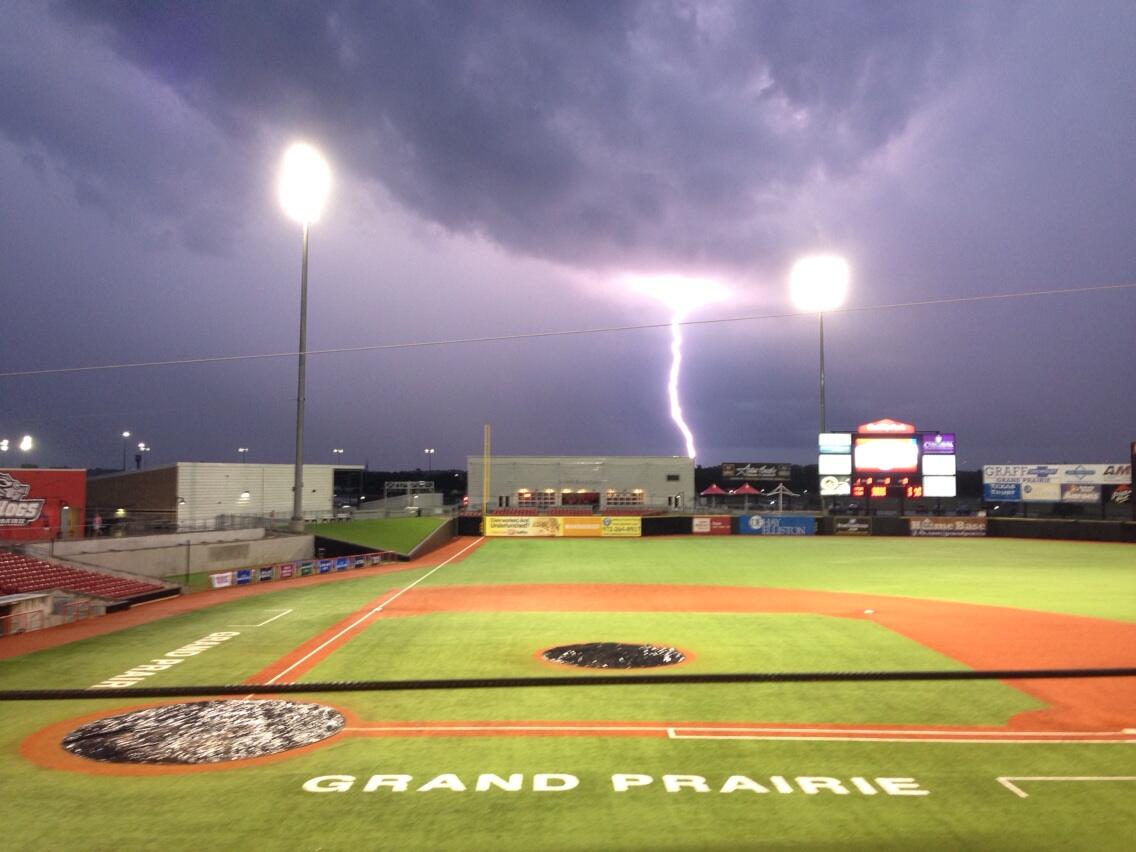
particularly due to some lightning delays.
It may be an artificial turf field, but preparing it
(and maintaining it) still takes some work!


25 May 2013

Why Friday night game was delayed

'Borrowed' from Twitter.

Um yeah, good decision. It's tough on both teams (UTSA, CSU Bakersfield) to have to get up, mentally, for such a big game the next morning, and it's terrible to affect both teams' starting pitchers, but Friday night's game had to be delayed. It will resume Saturday morning at 10 a.m. CT.

24 May 2013

A Fernando sighting!?

Courtesy WACSports.com
Kind of looks like I was calling a game pitched by Fernando Valenzuela on Thursday, doesn't it?

That's actually CSU Bakersfield senior lefty Jonathan Montoya, who stands just 5-foot-8 and throws a mean change-up. He was part of Bakersfield's first recruiting class and holds the school record with 20 career wins, including the Roadrunners' win over Sacramento State in both teams' second game of the WAC tournament.

For more on the WAC tournament, visit Tournament Central. I'll try to have some highlights up in the next couple of weeks.

23 May 2013

Great 1st day in the books at WAC tourney

Whenever I get the chance to attend a baseball game, I'm reminded of how much I love the sport and most of what goes on around it. I have a particular affinity for the college game, having been deeply involved in it as a college student, and Wednesday's opening day of the WAC Tournament in Grand Prairie, Texas, was a reminder of plenty of the great things about college baseball.

Of primary importance, of course, were the games. All three were competitive, two very close, and one - the opener - provided a lasting memory. UTSA and Sacramento State battled into 14 innings with great pitching and one dramatic double play before R.J. Perucki led off the bottom of the 14th with a no-doubt, walk-off home run to deep left field. My call may not have been an epic one, but given that it was my first baseball game in two years, I felt OK about the result -- check it out here courtesy of UTSA's Soundcloud account.

The middle game had some of that college spirit, as the very vocal San Jose State dugout made up for a slight lack of crowd noise, with both SJSU and CSU Bakersfield understandably bringing very few fans to Texas. Nothing like a little bench jockeying to provide some atmosphere!

The nightcap featured the two co-hosts, UT-Arlington and Dallas Baptist, and had by far the best atmosphere of the games. I could let the game breathe for 10-15 seconds at a time, and the ambient noise in the stadium sounded like a baseball game anywhere in the country. It was a tense one, too, with UT-Arlington starter Brad Vachon recovering from a rough 2nd inning to pitch into the 8th inning, allowing only two hits and striking out 11. An amazing performance, considering there were relievers throwing in the bullpen almost every inning.

One day in the books and four more to go here in Grand Prairie - let's hope the whole tournament is this much fun!

21 May 2013

Players to watch at the WAC baseball tournament

NMSU's Bobby Lecount led the WAC in OPS this year.
I'm on my way to the Dallas-Fort Worth Metroplex today to call the 2013 WAC Baseball Championship at QuikTrip Park in Grand Prairie. The games - three per day until Sunday's championship game - can be seen on WACSports.tv.

Here are a few of the individuals who have caught my eye while preparing for the tournament, all well worth watching this week:

CSUB – LHP Jeff McKenzie was a struggling junior college outfielder two years ago when his team ran out of pitchers in the highly competitive California state tournament. Having thrown only five innings all year, McKenzie took the hill and threw a complete-game victory. CSU Bakersfield offered him a scholarship based on that performance, and he has repaid the favor with a 2.67 ERA last year and an amazing 12-2, 1.79 line in 2013. His streak of 11 consecutive wins was broken last Friday by San Jose State, who he could face in Wednesday’s opener.

UT-Arlington – DH Matt Shortall is from the Dallas area and transferred back to home from Tulane after the 2011 season. Think he’s important to his team’s offense? Consider that he has 21 more RBI (54) than the next closest teammate (33).

Texas State – RHP Austen Williams had a minor role in Texas State’s bullpen in the first month of the season, but he has been nearly untouchable since March 3, allowing just two earned runs in his last 22 innings (0.82 ERA), lowering his season ERA from 11.37 to 2.93. Williams, closer Hunter Lemke (1.42 ERA in his last 38 innings), and lefty Donnie Hart (2.21 ERA) make for the league’s top bullpen.

UTSA – C John Bormann has thrown out an amazing 29 of 49 runners trying to steal against him this year (59 percent!) and has picked 14 runners off first base. It's hard to find context for how impressive those numbers are. I can't find a list of NCAA leaders (they apparently don't deal with fielding stats), but UTSA informs me Bormann ranks 2nd in the country in throwing out runners and first in runners picked off. The best college arm I've ever seen, that of Rice catcher Justin Ruchti, threw out 60 percent of runners (23/38) in the 2003 national-championship season. An arm like that behind the plate really limits the options for opposing teams to move baserunners.

Sacramento State – 1B Chris Lewis was told by head coach Reggie Christiansen that he should go to junior college before trying to contribute at Sacramento State. Lewis said, ‘No thanks’ and enrolled, took a redshirt last year, and proceeded to light up the WAC this year to the tune of .396/.439/.545 in conference play. Lewis gets good lineup protection from 2012 WAC Player of the Year Andrew Ayers, and both will need to play big roles if the Hornets, who were 9th in the WAC in hitting, can perform better at the plate in the postseason.

New Mexico State – 3B Bobby Lecount is a Moneyball type of player who seems to personify New Mexico State’s hitting philosophy. He walks a lot, strikes out a lot, and hits for serious power. In WAC play, he ranked first in OPS (1256), slugging (.778), OBP (.478), and walks (21) and finished 2nd in home runs (9) while striking out once per game.

Dallas Baptist – 3B Duncan McAlpine erupted with a 10-for-16 series against Texas State last weekend that included 4 home runs, and 11 RBI to finish first in the WAC in conference home runs (12) and second in slugging (.697). He is one of several ringleaders of the Patriots’ grip-it-and-rip-it offense on a team with serious postseason experience.

San Jose State – RHP Kyle Hassna was the Spartans’ main weapon out of the bullpen for most of the year, but he stepped into the starting rotation near the end of the season and provided a very strong start against CSU Bakersfield. If he can pitch in the vicinity of his 2.50 ERA in the tournament, it gives the undermanned Spartans a fighting chance in an extra game.

20 May 2013

Calling this week's WAC baseball tournament

In a departure from most of my recent broadcasting and blogging but a return to my roots, I’m really excited to be calling the Western Athletic Conference baseball tournament this week in Grand Prairie, Texas. I started my broadcasting career in college baseball in 2002 at Rice University, which was in the WAC at the time (although there was no conference tournament then) and I’ve been trying to find college baseball work all season, so this is going to be a lot of fun.

The tournament has two groups of four teams each, combining for three games per day from Wednesday-Saturday. That’s right, games at 11 a.m., 3 p.m., and 7 p.m. (all Central Time) all by my lonesome for four days in a row. Then a one-off championship game on Sunday. It’s going to be crazy. And hot, I’m thinking, thanks to the artificial turf at QuikTrip Park. You can check out the games at WACSports.tv, although it looks like there will be a charge to watch games.

I’ve been studying the WAC teams intently for the last two weeks, and here’s a very quick look at the teams in the tournament and some of their characteristics.

The favorites:
CSU Bakersfield led the league throughout the regular season thanks to its outstanding pitching, but the Roadrunners dropped their final series of the season to San Jose State, which is the team they will face first on Wednesday. CSU Bakersfield is only in its fifth season of D-I baseball and is looking for its first NCAA tournament berth.
UT-Arlington claimed a share of the regular-season title after an impressive three-game sweep of Sacramento State on the final weekend of the year. The Mavericks reached the NCAA tournament last year after winning the Southland Conference and have a balanced squad with a strong bullpen.
Texas State led the league in OPS and was second in ERA during conference play, including the league’s best bullpen. But the Bobcats slipped to third place because of their atrocious defense. In one four-game stretch last week, they made 19 errors, and they field at a .957 clip, by far the worst in the league.

In the mix:
Sacramento State came agonizingly close to its first NCAA tournament berth last year, needing to win one of two games against Fresno State in the WAC tournament final, but losing the second in an epic, 13-inning loss. The Hornets built their success on pitching and defense, but both seemed to desert them in last weekend’s series loss to UT-Arlington. If their pitching rebounds this week, they’re a big threat.
Unsung UTSA also passed Sacramento State on that final weekend, and the Roadrunners are interesting as an aggressive hitting team that does not rely on power. They swing early and often in the count and may have just enough quality arms to make a run.
After reaching NCAA regionals the last two years (and the super regionals in 2011) as an independent, Dallas Baptist spent its lone year in the WAC as the preseason favorite. The swing-from-their-heels Patriots are all power, all the time at the plate, but their pitching and defense have not matched expectations.
New Mexico State also made the NCAA tournament last year after winning the WAC regular season. The Aggies always put up big offensive numbers in terms of power, walks, and strikeouts, and this team is no exception. The pitching staff has powerful arms but ranked last in the WAC in ERA.

Long shot:
San Jose State squeaked in the tournament by taking two of the three games against CSU Bakersfield on the season’s final weekend, with both wins coming in the final at-bat. The Spartans hit for average without much power and really do not have the pitching depth needed to win four games in a row, but stranger things have definitely happened.

If I learned one thing from following WAC baseball over the last several weeks, it’s that very few games go according to either team’s plane, and lots of late lead changes are the norm. Most importantly, I don’t think any of the teams are in the running for an at-large bid to the tournament, so they’re all going to be playing desperate baseball throughout. Should be an exciting week!

08 April 2013

Ten years later: The Streak

DataOmaha.com
It wasn't part of the streak, but Rice went on
to win the 2003 national title.

April 8 marks the 10-year anniversary of the most impressive sports streak I have ever personally witnessed, Rice University’s 30-game baseball winning streak in 2003. Ten years ago tonight, Rice beat Texas A&M 8-0 at Reckling Park in Houston to record the Owls’ 30th consecutive win and run the team’s record to 33-1 on the season. They stood just four wins away from tying the Division I record of 34 consecutive wins, set by Texas in 1977, and 10 games shy of the NCAA record of 40 consecutive wins, set by Division III Marietta College (Ohio) in 1999.

Rice's streak came to an abrupt end the next night, with Lamar beating Rice 7-5. Somewhat appropriately, Rice will play Lamar head-to-head on Tuesday night, this time in Beaumont, 10 years to the day after the Cardinals ended Rice’s run. That Lamar win actually sent Rice into a tailspin that saw the Owls go 4-6 in their next 10 games and finish the regular season 15-9.

But the story has a happy ending for Rice alumni like me, as Rice went 10-2 in the NCAA tournament and won its first – and only – national championship, finishing a remarkable 58-12. As a Rice sophomore and radio broadcaster for the baseball team at the time, that entire season provided a series of special memories impossible to forget.

With my scorebooks packed away in storage, looking back at a simple list of results to remember the 30-game win streak is a bit odd. I actually don’t remember that many of the individual games, which is rare for me. Here, however, are a few I definitely recall:

Feb. 23 – Game No. 5 – A dreary Sunday afternoon at the end of a home tournament, Rice and UT-Arlington made it all the way to the 10th inning without scoring before a bloop single from Austin Davis gave Rice the win. Coming on the heels of a 6-0 win over SEC power Ole Miss, it felt like a prime example of a trap game, but Rice somehow found a way to win.

March 11 – Game No. 13 – The big one. Rice 2, Texas 1, a scoreline that never gets old. Enrique Cruz hit a dramatic late-game home run – to the opposite field – while Wade Townsend hit 97 on the radar gun with a strikeout of Omar Quintanilla and David Aardsma helped keep UT at 1 run in the late going. For a Rice person, it doesn’t get much better than that.

March 21 – Game No. 19 – Rice 20, Liberty 1 – It’s a mismatch and a blowout, of course, but I remember it because fourth-string walk-on catcher Jon Gillespie, a favorite of everybody involved with the program, got in the game and pulled a single through the right side. Jon wound up finishing with the highest batting average of any Rice player in 2003: a perfect 1.000.

April 8 – Game No. 30 – Rice 8, Texas A&M 0 – With Rice playing in the WAC at the time, facing Big 12 opposition on Tuesdays was a big deal, and Rice downed Texas, Nebraska, Baylor, and A&M during the streak, including this comprehensive demolition to reach No. 30.

I’ll leave you with the opening from an old newspaper article that includes one of my favorite ledes I've ever written, appearing the week before the streak came to an end:

Crash Davis, the wise catcher in the movie Bull Durham, once said “a player has to respect the streak.”
Rice baseball players respect their school-record 26-game winning streak, but they aren’t afraid to talk about it.
“It’s a blast,” sophomore first baseman Vincent Sinisi said. “We came back this year with a lot of confidence, and that’s all it is – a bunch of confidence. Everybody comes out every night expecting to win the ballgame.”
The Owls have won almost every ballgame for the past month and a half, running their record to 29-1 and claiming the consensus top ranking in the country.

03 March 2013

Baseball season is here

Centenary vs. Dallas at Shehee Stadium.
I've lived in Shreveport since last August, but I had yet to take in a sporting event until today. Although the local minor-league baseball and hockey teams have folded within the last five years (bad timing!), the town has a lot of sports action - there's the Independence Bowl, Division III Centenary College, NAIA LSU-Shreveport, and a thriving high school scene. But I'm often out of town on weekends, and when I'm in town, family comes first.

Alone with our beagle on this beautiful Sunday afternoon, I decided to see if either college was playing baseball this afternoon, and in the end, our dog and I spent a fun afternoon at breezy Shehee Stadium, watching the Centenary Gents edge the University of Dallas 4-3 in the rubber game of a three-game SCAC series. Read on for a light-hearted look at the afternoon, complete with more photos: