One of my favorite MLS-related tasks over the last few years has been trying to track which players in college soccer have ties to MLS academies and are eligible to sign home-grown contracts. It's pretty cool to be able to nod understandingly when Alex Dixon, Connor Lade, or Matt Lampson signs a home-grown contract and be able to say they had been on your radar for a few years.
So I have a long list of players I believe to be associated with each club, although confirming their status on that club's protected-player list is usually tricky, if not impossible. This summer, I worked with the tireless Travis Clark at Top Drawer Soccer, and he's posted some of the top MLS-associated players to watch in college soccer this year. The list is a must-read and will get you acquainted with guys who could definitely be in MLS next year.
I agree with all the names on that list, but I wanted to add a few more that you may want to keep an eye on. Check them out after the jump:
24 August 2012


21 August 2012
Catching up ... and relocating!
I've been too preoccupied to post for the last month or so, so my apologies on that front. We've been in the middle of a move from Philadelphia to Shreveport, Louisiana, and that has taken up most of my time. Things are relatively settled in Shreveport now, so I can get back to the sports business at hand.
In the last 6 weeks, I've called the beginning of the FC Dallas resurgence (its first road win, 2-1 over Colorado - check out the highlights with the TXA 21 commentary, which are unavailable on the MLS website) and part of the Houston Dynamo's five-game win streak (its first win outside the United States, 2-0 over Toronto - check out the highlights). In the process, I got to work with two great color analysts: Ian Joy for the FC Dallas game and Eddie Robinson for the Dynamo game.
Ian has been my most frequent partner in crime in Big D this year, and we enjoyed celebrating his birthday after the July 14 game. Unfortunately for our FCD broadcast team, Ian has accepted a position as analyst for BeIN Sports USA, where he will be an analyst for mostly European matches. I'm disappointed that we won't be working together again in the near future, but excited for him because I think he's a terrific analyst and friend.
Eddie is a long-time colleague and friend from my days working for the Dynamo, of course, and I'm actually going to take some of the credit for starting his broadcast career! He had knee surgery early in the 2009 season and was watching training from the stands near me one morning. He had a litany of comments on a recent national broadcast we had both watched and clearly felt strongly about broadcasting, so I invited him to join me on the radio broadcast for a game when our normal analyst was out of town. He accepted, and though unfortunately no recording of the game exists (I'm pretty sure it was the 0-0 tie against New York), he did very well in his first outing.
Fast forward three years, and Eddie has transitioned to coaching in the Dynamo Academy and regularly working as a color analyst on television broadcasts. He was a rough, physical player, but anybody who covered the Dynamo knows that Eddie Robinson has always been an honest, articulate quote, win or lose. He is the same way as a broadcaster, candidly pointing out both Xs and Os and more subtle nuances with straightforward, easy-to-understand terminology that I believe help fans understand the action. It was great to work with him on a Dynamo game again and catch up off the air.
College football coming your way
Since then, my focus has broadened to include the college football season. I am excited to say that I am scheduled to call four Division I college football games in the next month for ESPN3, all involving Sun Belt Conference teams. Working on a college football television broadcast was one of my main goals at the beginning of the year (while I have called football before and worked on television before, it's my first foray into televised football), so I am proud (and a little bit nervous) to get the chance. Check out my updated broadcast schedule for a list of games, outlets, and partners as they are confirmed.
I'll be posting about those college football games on this site - both about the games themselves and about my experience traveling to and calling them - but I am still a total MLS junkie, and I still have three soccer broadcasts scheduled this fall, so I won't back off the soccer commentary either. That should mean increased blog content all fall, so stay tuned ...
In the last 6 weeks, I've called the beginning of the FC Dallas resurgence (its first road win, 2-1 over Colorado - check out the highlights with the TXA 21 commentary, which are unavailable on the MLS website) and part of the Houston Dynamo's five-game win streak (its first win outside the United States, 2-0 over Toronto - check out the highlights). In the process, I got to work with two great color analysts: Ian Joy for the FC Dallas game and Eddie Robinson for the Dynamo game.
Ian has been my most frequent partner in crime in Big D this year, and we enjoyed celebrating his birthday after the July 14 game. Unfortunately for our FCD broadcast team, Ian has accepted a position as analyst for BeIN Sports USA, where he will be an analyst for mostly European matches. I'm disappointed that we won't be working together again in the near future, but excited for him because I think he's a terrific analyst and friend.
Eddie is a long-time colleague and friend from my days working for the Dynamo, of course, and I'm actually going to take some of the credit for starting his broadcast career! He had knee surgery early in the 2009 season and was watching training from the stands near me one morning. He had a litany of comments on a recent national broadcast we had both watched and clearly felt strongly about broadcasting, so I invited him to join me on the radio broadcast for a game when our normal analyst was out of town. He accepted, and though unfortunately no recording of the game exists (I'm pretty sure it was the 0-0 tie against New York), he did very well in his first outing.
Fast forward three years, and Eddie has transitioned to coaching in the Dynamo Academy and regularly working as a color analyst on television broadcasts. He was a rough, physical player, but anybody who covered the Dynamo knows that Eddie Robinson has always been an honest, articulate quote, win or lose. He is the same way as a broadcaster, candidly pointing out both Xs and Os and more subtle nuances with straightforward, easy-to-understand terminology that I believe help fans understand the action. It was great to work with him on a Dynamo game again and catch up off the air.
College football coming your way
Since then, my focus has broadened to include the college football season. I am excited to say that I am scheduled to call four Division I college football games in the next month for ESPN3, all involving Sun Belt Conference teams. Working on a college football television broadcast was one of my main goals at the beginning of the year (while I have called football before and worked on television before, it's my first foray into televised football), so I am proud (and a little bit nervous) to get the chance. Check out my updated broadcast schedule for a list of games, outlets, and partners as they are confirmed.
I'll be posting about those college football games on this site - both about the games themselves and about my experience traveling to and calling them - but I am still a total MLS junkie, and I still have three soccer broadcasts scheduled this fall, so I won't back off the soccer commentary either. That should mean increased blog content all fall, so stay tuned ...
13 July 2012
Three keys for FCD against Colorado on TXA 21 Saturday night
After almost two months without working an FC Dallas game, I’m back on the call in the Metroplex on Saturday night, teaming up with Ian Joy on the TXA 21 broadcast of FC Dallas-Colorado Rapids at 8 p.m. CT.
These teams met back on May 6 in Frisco, with Colorado winning 2-0 after Daniel Hernandez and Blas Pérez were BOTH sent off in a three-minute span in the first half, leaving Dallas with just nine men for the rest of the game.
A lot has happened since then, and some Thursday night rumors have been heating up about Toronto midfielder Julian de Guzman potentially being traded to Dallas. But regardless of whether or not FCD has a new center mid, here are three of the key matchups for FC Dallas on Saturday:

* A reminder that you can use Twitter to ask questions of myself and analyst Ian Joy during Saturday’s game by using the hashtag #FCDTV- we'll answer some questions prior to the second-half kickoff.
These matchups are very subject to change, because both teams are unpredictable in terms of formation and personnel, especially with Colorado’s different formations (4-3-3, 4-4-2, 4-1-4-1) and Dallas’ continued injuries and now personal absences. Blas Pérez, sadly, lost his father this week, so you have to assume he won’t be in the lineup, which leaves Dallas without a proven forward. Brek Shea has been playing up top, but we know he’s more comfortable as a wide midfielder. Despite his inconsistency, the speedy Fabian Castillo has a favorable matchup against Colorado right back Hunter Freeman, so I think we might see Shea stay up top.
I'm really interested to see how these teams fare and how their coaches handle some big decisions this weekend - join us on TXA 21 for the broadcast at 8 p.m. CT!
These teams met back on May 6 in Frisco, with Colorado winning 2-0 after Daniel Hernandez and Blas Pérez were BOTH sent off in a three-minute span in the first half, leaving Dallas with just nine men for the rest of the game.
A lot has happened since then, and some Thursday night rumors have been heating up about Toronto midfielder Julian de Guzman potentially being traded to Dallas. But regardless of whether or not FCD has a new center mid, here are three of the key matchups for FC Dallas on Saturday:
- Set Pieces – Big in any game, set pieces loom especially large because of Colorado’s recent troubles defending them and a serious FC Dallas size advantage. Colorado’s tallest regulars are Conor Casey and Jeff Larentowicz at 6-foot-1. After that, Drew Moor at 6-foot-0 and Jaime Castrillon at 5-foot-11 are next tallest. As you can see above, Colorado’s set-piece strategy has been to position Larentowicz and Moor as zonal markers along the 6-yard box, with 4-6 man markers at the top of the penalty area and nobody covering either post. That leaves shorter players, other than Casey, marking opponents’ primary targets, so driven delivery that lands between the zonal markers can put the Rapids under serious pressure.
Dallas, meanwhile, boasts big targets in Matt Hedges (6-4), Brek Shea (6-3), Andrew Jacobson (6-2), James Marcelin (6-2) if he starts, and Hernan Pertúz (6 feet). That’s four players taller than Colorado’s tallest, not counting goalkeepers. What’s more, David Ferreira is back and can provide consistently dangerous service, something Daniel Hernandez has struggled to do. After Seattle scored two goals on poor Rapids marking last week, expect Schellas Hyndman and Dallas to look for set pieces early and often. On the other side, it will be interesting to see if Oscar Pareja sticks with the same marking system or tries something new to fix a recurring problem. - Defending the Dynamic Duo – Feared as one of the most formidable forward tandems in MLS, Conor Casey and Omar Cummings are a handful for any defense. Colorado is fourth in MLS in scoring at home, averaging two goals per game, which will test a young Dallas back line (Zach Loyd-24 years old, Hernan Pertúz-22,Matt Hedges-22,Carlos Rodriguez-21) that has grown confident after allowing just one goal in the last three games. All three of those games were at home, however; Dallas has the second-worst road defense in MLS, allowing 2.13 goals per road game. Meanwhile, Casey and Cummings have only started together twice this season, but the Rapids had 31 shots in those two games, and expect to see them put a lot of pressure on Kevin Hartman in goal.
- Second Stanza – While Dallas is one of the worst second-half teams in MLS, Colorado is one of the best. The Rapids have scored 18 of their 25 goals in the second half, including nine goals in the final 15 minutes, which trails only the 'Goonies-never-die' Earthquakes in MLS. Dallas, meanwhile, has surrendered 21 goals in the second half, ranking second-worst after only expansion Montreal. Perhaps most surprisingly, Dallas has only trailed at halftime twice this season, yet its record when leading or tied at the half is a frustrating 3-7-7. Dallas is going to have to close the deal to break either its four-game road losing streak or its 14-game all-competitions winless streak.
* A reminder that you can use Twitter to ask questions of myself and analyst Ian Joy during Saturday’s game by using the hashtag #FCDTV- we'll answer some questions prior to the second-half kickoff.
These matchups are very subject to change, because both teams are unpredictable in terms of formation and personnel, especially with Colorado’s different formations (4-3-3, 4-4-2, 4-1-4-1) and Dallas’ continued injuries and now personal absences. Blas Pérez, sadly, lost his father this week, so you have to assume he won’t be in the lineup, which leaves Dallas without a proven forward. Brek Shea has been playing up top, but we know he’s more comfortable as a wide midfielder. Despite his inconsistency, the speedy Fabian Castillo has a favorable matchup against Colorado right back Hunter Freeman, so I think we might see Shea stay up top.
I'm really interested to see how these teams fare and how their coaches handle some big decisions this weekend - join us on TXA 21 for the broadcast at 8 p.m. CT!

12 July 2012
Home-grown cage match: FC Dallas vs. Toronto FC
The FC Dallas signing of home-grown defender/midfielder Kellyn Acosta on Thursday got me thinking. If the two most successful MLS academies in terms of home-grown players signed (7 each, by FC Dallas and Toronto FC) met on the field with only those players, who would win?
Here's what such a 7-on-7 matchup could look like, although the size and surface of the field and the rules of the game would surely affect how teams chose to lineup.
Here's what such a 7-on-7 matchup could look like, although the size and surface of the field and the rules of the game would surely affect how teams chose to lineup.
FC DALLAS (2-2-2)
GK Richard Sanchez (18yo)
DF Kellyn Acosta (16yo) ------------------ DF Moises Hernandez (20yo)
MF Victor Ulloa (20yo)
MF Bryan Leyva (20yo)
FW Jonathan Top (19yo) ------------------ FW Ruben Luna (20yo)
FW Keith Makubuya (19yo)
MF Nicholas Lindsay (19yo) ------------------------------- MF Matt Stinson (19yo)
MF Oscar Cordon (19yo)
MF Oscar Cordon (19yo)
DF Ashtone Morgan (21yo) ------------------ DF Doneil Henry (19yo)
GK Quillan Roberts (17yo)
TORONTO FC (2-3-1)
Now it's an interesting game, but I'm giving the edge to Toronto because the combined experience of Morgan and Henry at the back would cancel out the main Dallas advantage - two forwards who have seen MLS game time - and limit Toronto's disadvantage in goal, where I think Richard Sanchez is further along than Quillan Roberts.
I like the Ulloa/Leyva tandem in the midfield, but even if Top dropped in to match Toronto's numbers, I don't think Dallas is getting on the board. Makubuya has yet to make his MLS debut, so Toronto could struggle up front, but the speed of a healthy (for the purposes of this exercise) Lindsay against the green duo of Acosta and Hernandez would put Toronto over the top.
Who do you think would make a difference in this game? Who would come out on top?
09 July 2012
My inner Canadian

The game itself was one-sided, which means finding good quotes and story angles can be difficult, but both Terry Dunfield and Jeremy Hall were very classy and well-spoken in defeat, so my thanks to them.
So far, my wondrous prose has appeared on the website of The Globe and Mail, the Toronto Star, and MetroNews Canada (with a huge, bold headline). Pretty cool! And yes, they switched out my "defense" for "defence" ... stylistic differences we may not solve overnight.

01 July 2012
Catching up from Saturday's blackout
While visiting Maryland for the weekend, I got caught in Saturday's blackout and spent the afternoon and evening sweating bullets in a powerless, wireless house, trying to take care of a couple of rambunctious canines. When reconnected to the world this morning, it seems I missed a stirring soccer Saturday in MLS.
Folks on Twitter kindly informed me that the Galaxy-San Jose game was mandatory viewing, so I had time to watch significant parts of that game and the Houston-Philadelphia game (old hometown vs. current city) before kicking back for Euro 2012 coverage. Here are five thoughts from those two games:
Folks on Twitter kindly informed me that the Galaxy-San Jose game was mandatory viewing, so I had time to watch significant parts of that game and the Houston-Philadelphia game (old hometown vs. current city) before kicking back for Euro 2012 coverage. Here are five thoughts from those two games:
- The atmosphere and emotion in the Galaxy-Earthquakes game was, as everybody else has already said, exceptional. It was a great night to showcase the league with a game that had intrigue well beyond the 4-3 scoreline, and it in some ways validated the MLS decision to go to an unbalanced schedule: More rivalry games means more potential for emotional encounters like this one. I now want to watch the October 21 game between these teams way more than I want to see the Galaxy or Quakes play another game against Columbus or Toronto.
- Geoff Cameron, who has been sloppy at best sometimes this year, turned in one of his best performances Saturday against Philadelphia. Moved into midfield in Dominic Kinnear's surprise (and effective) switch to match the Union's 4-3-3, Cameron showed off flashy dribbling moves, inventive passes, and hard tackling. He made mistakes, but certainly showed well for a potential move to Europe. I've always thought Cameron was best in midfield, where his height and size make him an outlier, and particularly at D-mid, where he excelled in the 2008 SuperLiga semifinal.
- Boniek Garcia appears to be a keeper. The Honduran right wing, who should simply be called 'Garcia' on second reference, both in print and on air, was thrown right into the starting lineup after two training sessions and was everything Houston wanted. He's technical on the ball, but what stood out to me was how he used his body to throw defenders off balance even when making simple passes. He played a big part in both of Houston's goals, defended honestly, and is exactly the additional offensive weapon the Dynamo needed in midfield.
- I hope MLS finally punishes David Beckham for his immature petulance. Hopefully you've seen it by now: Beckham, feeling aggrieved from a night of physical play and close decisions, intentionally kicked a ball at a prone opponent during a stoppage in play. Brek Shea got three games for kicking a ball at an official (an act that was far less pre-meditated than Beckham's); I think Beckham's suspension should exceed that one.
- An end-zone camera should be a non-negotiable component for every MLS broadcast. The LA-San Jose broadcast, by ESPN, showed us some of the potential of having cameras throughout the stadium, with great angles used to illustrate key calls. The Houston-Philly game, with an understandably smaller production, missed its chance to show the game by choosing not to use an end-zone camera. All three goals could have been better understood by fans with use of an end-zone angle, especially Keon Daniel's goal (which I believe took a wicked deflection other cameras could not detect) and Brian Ching's penalty kick. Adding a camera for every production is a significant cost, but one worth paying.
27 June 2012
10 years since Clint Mathis was left off the MetroStars lineup sheet
 |
| Clint Mathis, the face of the franchise, was left off the lineup sheet. (Courtesy BigAppleSoccer.com) |
Wednesday night was a very important milestone in MLS
history. It was the 10th anniversary of my first MLS game as an employee! (The
game was on June 26, 2002, but I felt a Wednesday was more appropriate to celebrate
the anniversary.) That’s right, 10 years ago, on a Wednesday night in the
Meadowlands, I was a communications intern for the MetroStars after my freshman year of college. I saw the MetroStars
lose (surprise!); Pablo Mastroeni get a red card (big surprise!); and sat
through an international game designed to draw additional
fans (it didn’t). Thus began my career in sports.
Perhaps more memorably for everybody else, Wednesday
night was the 10th anniversary of the infamous game in which Clint Mathis was
supposed to make his return to MLS following the World Cup, but was denied
entry as a second-half sub because (wait for it …) he had been omitted from the
team’s lineup sheet. It was an extremely high-profile blunder that hurt
the MetroStars’ chances to win the game and cost an assistant coach his job.
And I could have stopped it.
Read on for the full story …
Rediscovering my own Friday-night lights
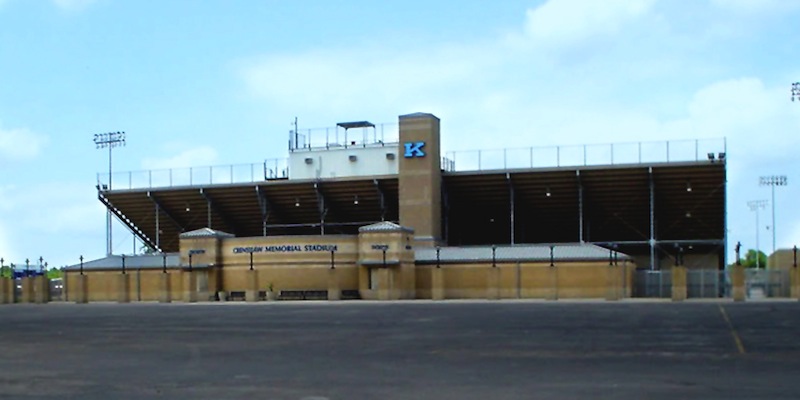
It took a true shot in the dark, but I discovered a
long-lost gem of a broadcast last night, hearkening back to the Friday-night lights of my past.
I’ve spent a lot of time this month sending out feelers about
broadcasting jobs in college sports for 2012-13. I have not, however, gotten a
lot of responses. But I continue to work on my online demo
page to try and impress potential employers.
My demo page had clips from a number of different sports,
but there was no football. That’s a gaping hole when I want to be considered
for college football broadcasts this year. I know football and do have experience
calling it, but the only recordings I had were from my first year calling high
school games, back in 2006, and they had a pretty significant hum from
internet-only recordings.
I knew the best football game I’ve called came on a
random Friday night in 2008, during my first year working for the Dynamo, when
I was called to fill in on the game of the week for Houston’s ESPN affiliate at
the time, 97.5 FM. I had always felt like that broadcast gave a much stronger
representation of my football skills. Unfortunately, I hadn’t been able to get
a recording of the game at the time and just assumed it didn’t exist.
So late last night, unable to sleep with a heightened sense
of urgency to improve my demo page with some football, I went back and listened
to a couple of those old games from 2006. I really didn’t feel good about sharing
those as examples of my “best work,” so I dug a little deeper. The Texas Sports Radio Network had given me my first chances to
broadcast high school football, and TSRN archives its games. I figured there
was no way anything went that far back, especially because the ‘archive’ button
on the website only took me to Houston high-school broadcasts from 2011-12.
This is where I got lucky. Because “/2011-12/” was
included as part of the URL, I surmised that other years, though not linked
anywhere on the site, might be available. So I replaced the 2011-12 with 2008-09, clicked ‘Football,’ and was presented with a list of games from 2008. I still worried
that my broadcast, having been on real radio rather than simply an internet
broadcast, would not be listed, but it was there!
Since each game had a link, presumably to a stream of the
broadcast, I thought I had solved the problem. But the detective work wasn’t
done. Clicking on the link brought me to an error page telling me the file did
not exist. That stumped me for a bit, but I noted the URL that was not coming
up and went back to compare it against the URLs from more recent archives that
were still available. There were obvious differences, so I substituted the
correct years and filename in the file path. After trying several different
variations without success – I was getting tired of being told the file did not
exist – I finally got a response, and an audio file started loading!
The file covered about eight hours, but luckily the main
focus of it was a three-hour broadcast of the game between Dayton and C.E.
King, with me on the play-by-play. What a relief! Listening to the game brought back some great memories of a crazy night at Crenshaw Memorial Stadium (pictured above) on the technical side and an impressive night on the football side. The game included Dayton quarterback Cody Green, who might be the starter at Tulsa this fall, and current UH hurdler Cameron LaCour, the brother of Nebraska track star Karyn LaCour, whom I profiled when I worked in Humble.
The trip down memory lane means I finally have some football
clips I can send to potential employers to show them I can handle it, even if
it is from four years ago.The full game is still available (be patient and
allow the audio file to load, then drag ahead to the game action), and here’s
the 14-minute clip on my demo page.
Some late-night industry and a little bit of luck, and
maybe somebody will take a chance on me calling football games after all!
12 June 2012
I want solutions, not problems!
I once had a great boss who insisted that if any of us brought up a problem, we should be prepared to suggest a solution at the same time. Sounds obvious, but it was great advice that I still try to use as much as possible.
So when it comes to the impact of Major League Soccer on the development of young players in the United States - about which Washington Post writer Paul Tenorio wrote a very interesting piece that ran today - I want to try to be a small part of the solution. It’s an extremely important topic for both MLS and American soccer, and Tenorio did a good job of efficiently discussing the multiple aspects of a very complex issue.
As far as possible solutions, Tenorio primarily mentions partnerships with minor-league clubs and an increased investment in the MLS Reserve League. Of the two, I would favor the latter, where players will remain more connected to the MLS club and will play, generally speaking, on better fields. MLS teams currently play 10-game Reserve League schedules, but several considerations - mostly financial, as I understand it - prevent the league from running a full 34-game Reserve League, in which each MLS fixture is mirrored at the lower level. Given the travel required and the lack of any tangible revenue from a reserve game in most markets, the financials will continue to make it a tough sell.
It is a third option that most intrigues me, however, one raised by MLSsoccer.com’s Jonah Freedman in this April column. Read on for more ...
So when it comes to the impact of Major League Soccer on the development of young players in the United States - about which Washington Post writer Paul Tenorio wrote a very interesting piece that ran today - I want to try to be a small part of the solution. It’s an extremely important topic for both MLS and American soccer, and Tenorio did a good job of efficiently discussing the multiple aspects of a very complex issue.
As far as possible solutions, Tenorio primarily mentions partnerships with minor-league clubs and an increased investment in the MLS Reserve League. Of the two, I would favor the latter, where players will remain more connected to the MLS club and will play, generally speaking, on better fields. MLS teams currently play 10-game Reserve League schedules, but several considerations - mostly financial, as I understand it - prevent the league from running a full 34-game Reserve League, in which each MLS fixture is mirrored at the lower level. Given the travel required and the lack of any tangible revenue from a reserve game in most markets, the financials will continue to make it a tough sell.
It is a third option that most intrigues me, however, one raised by MLSsoccer.com’s Jonah Freedman in this April column. Read on for more ...
11 June 2012
Euro 2012 all-Yardley team, 8 games in
 |
| The Ukrainian old guard, Shevchenko and Voronin, prepare to celebrate. |
Subscribe to:
Posts (Atom)