20 May 2013

Calling this week's WAC baseball tournament

In a departure from most of my recent broadcasting and blogging but a return to my roots, I’m really excited to be calling the Western Athletic Conference baseball tournament this week in Grand Prairie, Texas. I started my broadcasting career in college baseball in 2002 at Rice University, which was in the WAC at the time (although there was no conference tournament then) and I’ve been trying to find college baseball work all season, so this is going to be a lot of fun.

The tournament has two groups of four teams each, combining for three games per day from Wednesday-Saturday. That’s right, games at 11 a.m., 3 p.m., and 7 p.m. (all Central Time) all by my lonesome for four days in a row. Then a one-off championship game on Sunday. It’s going to be crazy. And hot, I’m thinking, thanks to the artificial turf at QuikTrip Park. You can check out the games at WACSports.tv, although it looks like there will be a charge to watch games.

I’ve been studying the WAC teams intently for the last two weeks, and here’s a very quick look at the teams in the tournament and some of their characteristics.

The favorites:
CSU Bakersfield led the league throughout the regular season thanks to its outstanding pitching, but the Roadrunners dropped their final series of the season to San Jose State, which is the team they will face first on Wednesday. CSU Bakersfield is only in its fifth season of D-I baseball and is looking for its first NCAA tournament berth.
UT-Arlington claimed a share of the regular-season title after an impressive three-game sweep of Sacramento State on the final weekend of the year. The Mavericks reached the NCAA tournament last year after winning the Southland Conference and have a balanced squad with a strong bullpen.
Texas State led the league in OPS and was second in ERA during conference play, including the league’s best bullpen. But the Bobcats slipped to third place because of their atrocious defense. In one four-game stretch last week, they made 19 errors, and they field at a .957 clip, by far the worst in the league.

In the mix:
Sacramento State came agonizingly close to its first NCAA tournament berth last year, needing to win one of two games against Fresno State in the WAC tournament final, but losing the second in an epic, 13-inning loss. The Hornets built their success on pitching and defense, but both seemed to desert them in last weekend’s series loss to UT-Arlington. If their pitching rebounds this week, they’re a big threat.
Unsung UTSA also passed Sacramento State on that final weekend, and the Roadrunners are interesting as an aggressive hitting team that does not rely on power. They swing early and often in the count and may have just enough quality arms to make a run.
After reaching NCAA regionals the last two years (and the super regionals in 2011) as an independent, Dallas Baptist spent its lone year in the WAC as the preseason favorite. The swing-from-their-heels Patriots are all power, all the time at the plate, but their pitching and defense have not matched expectations.
New Mexico State also made the NCAA tournament last year after winning the WAC regular season. The Aggies always put up big offensive numbers in terms of power, walks, and strikeouts, and this team is no exception. The pitching staff has powerful arms but ranked last in the WAC in ERA.

Long shot:
San Jose State squeaked in the tournament by taking two of the three games against CSU Bakersfield on the season’s final weekend, with both wins coming in the final at-bat. The Spartans hit for average without much power and really do not have the pitching depth needed to win four games in a row, but stranger things have definitely happened.

If I learned one thing from following WAC baseball over the last several weeks, it’s that very few games go according to either team’s plane, and lots of late lead changes are the norm. Most importantly, I don’t think any of the teams are in the running for an at-large bid to the tournament, so they’re all going to be playing desperate baseball throughout. Should be an exciting week!

11 April 2013

The demo reel


Those of us trying to make a career in broadcasting have quickly learned that it takes a lot more than a deep voice or a knowledge of sports to find work on the airwaves. It takes preparation, connections, practice, and a little bit of luck. But one of the most important calling cards – and part of the process that you can control – is the demo reel. (Here's my current crop)

Making a demo reel is no simple task. It is completely impractical to make a separate reel for each job one applies for, yet each hiring manager is looking for something different. One network may value letting the game breathe, while another may value over-the-top histrionics. Some may prioritize play-by-play work, some may be most focused on your comfort level in front of a camera, and still others most want to hear how you call the big play. A demo reel should find a way to impact any viewer.

This year I’m trying to raise the level of my demos by adding some excitement up front. I may be laid-back, but I like to think I know when to get excited, and I need to show that to producers.

So for my latest soccer demo, I gathered some of my favorite calls from the last four years of soccer broadcasting. As you may imagine, this was half the fun! Looking back on some of the most dramatic and memorable moments from the past few years (and evaluating my call of the play) probably took up the better part of 2-3 days. I went back through my highlight DVDs from the 2009 and 2010 Dynamo seasons and looked at most of my televised broadcasts from 2011-12, wrote down what I thought were the best calls and plays to grab someone’s attention, and then began to narrow the list.

The finalists amounted to about 12 minutes of footage, and that’s without almost anything from the 2011 Dynamo season, since I don’t have easy access to video from that year. Since I was aiming to keep the total demo around 10 minutes long, and I still had to fit in some play-by-play, cuts were a necessity.

As I narrowed things down, I also had to choose between putting all the highlights together or splitting up the radio and television calls. Since so much of my career has been in radio, and those are some of my most passionate calls, I definitely wanted them in there. But games are called very differently between radio and television, so in the end, I decided to split up the radio and television calls, labeling them appropriately.

Once I had the highlights down to about 5 minutes, 30 seconds, I had to identify a good on-camera clip so that television producers know what I look like. Last year was my first year in television, and it definitely took me a little while to get comfortable in front of a camera. I wound up going with part of the demo that helped land my ESPN3 work last year, an opening with Brian Dunseth from a Dallas-Philadelphia game.

I wanted to use a different game as an example of play-by-play, but after checking out a few clips, I decided it was important not to use a game I called remotely from a studio. While it is a skill in its own right, calling a game from studio does restrict your sense of atmosphere and does not allow for the sort of perspective I tend to use in a broadcast. So I picked a five-minute segment from a Dallas-Seattle game that included chances at both ends and a discussion with partner Ian Joy about the importance of a halftime substitution.

In the end, I've got a video less than 15 minutes long that should give you an idea of what I bring to the table as a soccer announcer. Hopefully it does the trick! Here's the final product:

08 April 2013

Ten years later: The Streak

DataOmaha.com
It wasn't part of the streak, but Rice went on
to win the 2003 national title.

April 8 marks the 10-year anniversary of the most impressive sports streak I have ever personally witnessed, Rice University’s 30-game baseball winning streak in 2003. Ten years ago tonight, Rice beat Texas A&M 8-0 at Reckling Park in Houston to record the Owls’ 30th consecutive win and run the team’s record to 33-1 on the season. They stood just four wins away from tying the Division I record of 34 consecutive wins, set by Texas in 1977, and 10 games shy of the NCAA record of 40 consecutive wins, set by Division III Marietta College (Ohio) in 1999.

Rice's streak came to an abrupt end the next night, with Lamar beating Rice 7-5. Somewhat appropriately, Rice will play Lamar head-to-head on Tuesday night, this time in Beaumont, 10 years to the day after the Cardinals ended Rice’s run. That Lamar win actually sent Rice into a tailspin that saw the Owls go 4-6 in their next 10 games and finish the regular season 15-9.

But the story has a happy ending for Rice alumni like me, as Rice went 10-2 in the NCAA tournament and won its first – and only – national championship, finishing a remarkable 58-12. As a Rice sophomore and radio broadcaster for the baseball team at the time, that entire season provided a series of special memories impossible to forget.

With my scorebooks packed away in storage, looking back at a simple list of results to remember the 30-game win streak is a bit odd. I actually don’t remember that many of the individual games, which is rare for me. Here, however, are a few I definitely recall:

Feb. 23 – Game No. 5 – A dreary Sunday afternoon at the end of a home tournament, Rice and UT-Arlington made it all the way to the 10th inning without scoring before a bloop single from Austin Davis gave Rice the win. Coming on the heels of a 6-0 win over SEC power Ole Miss, it felt like a prime example of a trap game, but Rice somehow found a way to win.

March 11 – Game No. 13 – The big one. Rice 2, Texas 1, a scoreline that never gets old. Enrique Cruz hit a dramatic late-game home run – to the opposite field – while Wade Townsend hit 97 on the radar gun with a strikeout of Omar Quintanilla and David Aardsma helped keep UT at 1 run in the late going. For a Rice person, it doesn’t get much better than that.

March 21 – Game No. 19 – Rice 20, Liberty 1 – It’s a mismatch and a blowout, of course, but I remember it because fourth-string walk-on catcher Jon Gillespie, a favorite of everybody involved with the program, got in the game and pulled a single through the right side. Jon wound up finishing with the highest batting average of any Rice player in 2003: a perfect 1.000.

April 8 – Game No. 30 – Rice 8, Texas A&M 0 – With Rice playing in the WAC at the time, facing Big 12 opposition on Tuesdays was a big deal, and Rice downed Texas, Nebraska, Baylor, and A&M during the streak, including this comprehensive demolition to reach No. 30.

I’ll leave you with the opening from an old newspaper article that includes one of my favorite ledes I've ever written, appearing the week before the streak came to an end:

Crash Davis, the wise catcher in the movie Bull Durham, once said “a player has to respect the streak.”
Rice baseball players respect their school-record 26-game winning streak, but they aren’t afraid to talk about it.
“It’s a blast,” sophomore first baseman Vincent Sinisi said. “We came back this year with a lot of confidence, and that’s all it is – a bunch of confidence. Everybody comes out every night expecting to win the ballgame.”
The Owls have won almost every ballgame for the past month and a half, running their record to 29-1 and claiming the consensus top ranking in the country.

05 April 2013

'Sabo'-metric look at scoring stat


Courtesy Real Salt Lake

There are a lot of statistics in soccer these days, and most of the time, I’m all for it. Finding numbers to illustrate key points or tracking long-running streaks can provide great talking points. But I get really frustrated when statistics are quoted out of context.

One such statistic caught my eye in this week’s MLSsoccer.com piece by Simon Borg, a friend and colleague with whom I love to argue and debate. In writing about Real Salt Lake forward Alvaro Saborío, Simon passed on a couple of statistics cited by Real Salt Lake GM Garth Lagerwey, presumably to indicate that Saborío is a clutch goalscorer and essential to his team’s success. The big statistic?

Real Salt Lake is 31-5-6 in all competitions when Saborío scores.

I have seen this stat used before in game notes, on television broadcasts, and in articles. But I have never found it to be particularly enlightening. After all, soccer is a low-scoring game. Isn’t it pretty obvious that a player scoring a goal is going to increase his team’s chances of winning? Don’t most teams have a high winning percentage when scoring at least one goal? Even if a team’s record when an individual scores is better than the team’s record when anybody scores, is it really because that player scored or is it perhaps because the team happened to play better defense in those games?

I asked Simon for his thoughts on the statistic, and he thought it was useful because it illustrated “the sense of Lagerwey and [head coach Jason] Kreis that [Saborío] is a clutch scorer. … There are plenty of scorers out there; not all of them show up when it counts.”

That’s certainly fair enough. I rate Saborío very highly and definitely consider him a key ingredient of Real Salt Lake’s success. I have enjoyed my conversations with both Lagerwey and Kreis, and I have an excellent relationship with the RSL communications staff. But I remained unconvinced that the statistic itself is all that indicative. I expected that most teams would have a winning record when their leading scorer found the net. I had no proof, however, so I set out to look at a few cases to test my theory.

In MLS last year, 13 players scored at least 10 goals. For each player, I went through his game-by-game log (thank you, Peter Hirdt and Elias Sports Bureau) and totaled his team’s record when he scores. I then looked up each team’s regular-season record when it scored at least one goal.

The win percentages based on individual scoring ranged from .500 (Will Bruin) to .857 (Steven Lenhart), with an average of .751 and a median of .773. Most of the numbers clustered between .750 and .789, and most players’ teams had suffered at least two losses when they scored.

The team numbers were, across the board, lower than the individual numbers, ranging from .500 (New England) to .818 (Real Salt Lake) and averaging .705.

Next, the crux of the issue: the difference between a team’s winning percentage when scoring any goal and its winning percentage when a particular individual scores. The average difference was .046, meaning a team wins 4.6% more of its games when its 10-goal striker scores than when just anybody scores. The highest number belonged to Steven Lenhart (.857 when he scored vs. 719 when any Earthquake scored), while the lowest number belonged to Will Bruin (.500 when he scored vs. .667 when any Dynamo player scored).

Player - 2012 seasonInd%Tm%Diff.
Steven Lenhart, SJ.857 (5-0-2).719 (19-5-8)+.138
Kenny Cooper, NY
.846 (10-1-2).714 (16-4-8)+.132
Saer Sene, NE.611 (4-2-3).500 (9-9-5)+.111
Robbie Keane, LA.750 (8-2-2).655 (16-7-6)+.095
Thierry Henry, NY.800 (8-2-0).714 (16-4-8)+.086
Chris Pontius, DC.833 (7-1-1).750 (17-4-5)+.083
Chris Wondolowski, SJ.789 (13-2-4).719 (19-5-8)+.071
Eddie Johnson, SEA.750 (8-2-2).704 (15-4-8)+.046
Fredy Montero, SEA.750 (6-1-3).704 (15-4-8)+.046
Alan Gordon, SJ.708 (7-2-3).719 (19-5-8)-.010
Kei Kamara, KC.773 (8-2-1).788 (18-3-5)-.016
Alvaro Saborio, RSL.800 (8-2-0).818 (17-3-2)-.018
Will Bruin, HOU.500 (2-2-6).667 (14-5-8)-.167
Nine of the 13 individuals had helped their team to a better win percentage when scoring, but Saborío (RSL was 8-2 when he scored) was actually one of the four who did not, along with Bruin, Alan Gordon, and Kei Kamara. Ironically, RSL was 7-0 in the 2012 regular season when since-traded forward Fabian Espindola scored.

Interestingly, a team’s defense might make it harder for a forward to steal the show. Of the seven players with the highest difference in the above table, all seven played for teams that allowed at least 43 goals. In the bottom six, only one (Gordon) played for a team that allowed at least 43 goals.

I would like to see Elias or Opta take a crack at these numbers and consider a much wider range of players and teams. But the data so far does not give me any reason to change my conclusion: Real Salt Lake does have a better chance of winning if Saborío scores, but not a significantly better chance than if anybody else scores.

16 March 2013

Something you don't see every day

Sometimes the little things in life are worth celebrating. On a perfectly ordinary Saturday night in Shreveport, I achieved a rare Scrabble feat. Faced with the letters A-E-G-I-I-M-T, I came up with:


MITIGATE, on the right of this picture, only scores 12 points, up from 11 thanks to the second T being on a double-letter score. But Scrabble has this wonderful 50-point bonus for using all the letters. I cannot remember ever hitting for the bonus before, but my play turned into a 62-point outburst that all but decided the game.

03 March 2013

Baseball season is here

Centenary vs. Dallas at Shehee Stadium.
I've lived in Shreveport since last August, but I had yet to take in a sporting event until today. Although the local minor-league baseball and hockey teams have folded within the last five years (bad timing!), the town has a lot of sports action - there's the Independence Bowl, Division III Centenary College, NAIA LSU-Shreveport, and a thriving high school scene. But I'm often out of town on weekends, and when I'm in town, family comes first.

Alone with our beagle on this beautiful Sunday afternoon, I decided to see if either college was playing baseball this afternoon, and in the end, our dog and I spent a fun afternoon at breezy Shehee Stadium, watching the Centenary Gents edge the University of Dallas 4-3 in the rubber game of a three-game SCAC series. Read on for a light-hearted look at the afternoon, complete with more photos:

02 March 2013

Most interesting MLS story of 2013? Chivas USA

Born in the U.S. but raised in Mexico, Josue Soto (left)
is a friend of mine from the Dynamo but is now part of
the Chivas USA overhaul.
The Major League Soccer storyline that most interests me entering 2013, by a wide margin, is Chivas USA.

Normally an afterthought and one of the league's least popular clubs, I'm interested because they are basically re-starting the club and returning to its original intent: to be an American version of Chivas Guadalajara, playing a Mexican style and fielding a mix of Mexican-Americans, Mexican players on loan, and Californians.

I have seriously mixed emotions about this mission. It smacks of prejudice. Employing almost exclusively players of a certain nationality/race? Hard to root for. From what I have heard, there has been a major emphasis that every member of the front office staff be able to speak Spanish, and the team has done away with English-language television broadcasts completely. Not exactly inclusive.

On the other hand, it's fascinating. The attempt to turn over most of the team in one offseason is fascinating. The attempt to play a Mexican style in an American league is fascinating. The attempt to gather promising Mexican-American players in one team is fascinating. The reported use of the 3-5-2 formation - little-seen in MLS since DC and New England, circa 2007, is intriguing. I can't take my eyes away.

The biggest flash point, of course, is the team's stated Mexican identity. As a United States fan, I have hated the Mexican national team - and, I thought, Mexican soccer in general - since I began following soccer. But working for the Houston Dynamo gave me a different perspective on the Mexican teams we faced in SuperLiga, Champions League, and friendlies. Yes, there was the condescension and dirty play that made me hate the Mexican national team. But I also learned to respect certain teams and certain players (while still wanting to beat them every time). I admired Pachuca's style of play, began to appreciate Santos' attacking movement. I am now far more interested in the Mexican league than I was six years ago, and I love watching the clash of styles when Mexican and American teams meet.

Chivas USA could bring that to MLS every week, and it could be really fun to watch. They could be a hated rival for every team with a fan base that loves the U.S. national team.

So when Chivas USA opens its season tonight at home against Columbus, I'll be watching closely. It sounds like there may not be a big crowd in the stadium to watch closely, but it's going to be the start of something epic. It may be an epic fail, if the team fails to perform and Southern California fans decide not to get on board. Or, if the team succeeds, it may produce an epic villain of a team that opposing fans love to hate. Either way, I'm fascinated.

For more on the Chivas USA makeover, read on for a list of players brought in during the 2012-13 offseason. All 14 are Hispanic.

27 February 2013

Rarely do I spend so much time on camera

With the Major League Soccer season kicking off on Saturday, I was invited to participate in a Google Hangout with two of my favorite soccer-talkers, Darrell Lovell (MLSsoccer.com beat writer for the Houston Dynamo) and Simon Borg (MLSsoccer.com editor). I can BS with these guys all day long, but we held it to 37 minutes in this video hosted on the Houston Dynamo website on Wednesday.

I may not know when/where/for whom I will be working during this season, but I can still talk a pretty good game. Here's a look back at our chat:

14 February 2013

More Tucson videos

A quick hello from Tucson, where I've been staying busy with MLS broadcast meetings (networking, networking, networking), the opening games of the Desert Diamond Cup (frigid night, but entertaining games), and sit-down interviews with players from both Real Salt Lake and the New York Red Bulls (really interesting and enjoyable.)

The interviews - Nat Borchers, Jason Kreis, and Dax McCarty were my favorites - will air later in the year as part of packages on MLSsoccer.com, but highlights from Wednesday's games are available now:

Seattle Sounders 2, New England Revolution 0 - a preseason game with the equivalent of four ejections!
Real Salt Lake 2, New York Red Bulls 2 - RSL scored two goals in the first three minutes, but New York rallied
and as a little bonus, video of me with broadcast partner and MLSsoccer.com editor-in-chief Greg Lalas doing an ice-cold post-game report from Tucson:

01 February 2013

My 2013 soccer season kicks off!

My 2013 broadcasting season is underway, as I'm at the Desert Friendlies in Tucson, Arizona, working on the MLSsoccer.com online broadcasts! After calling Houston-Colorado tonight, I'll work a game Friday, two games Saturday, and wrap up the trip with Seattle-Portland on Tuesday morning.

Game highlight package:

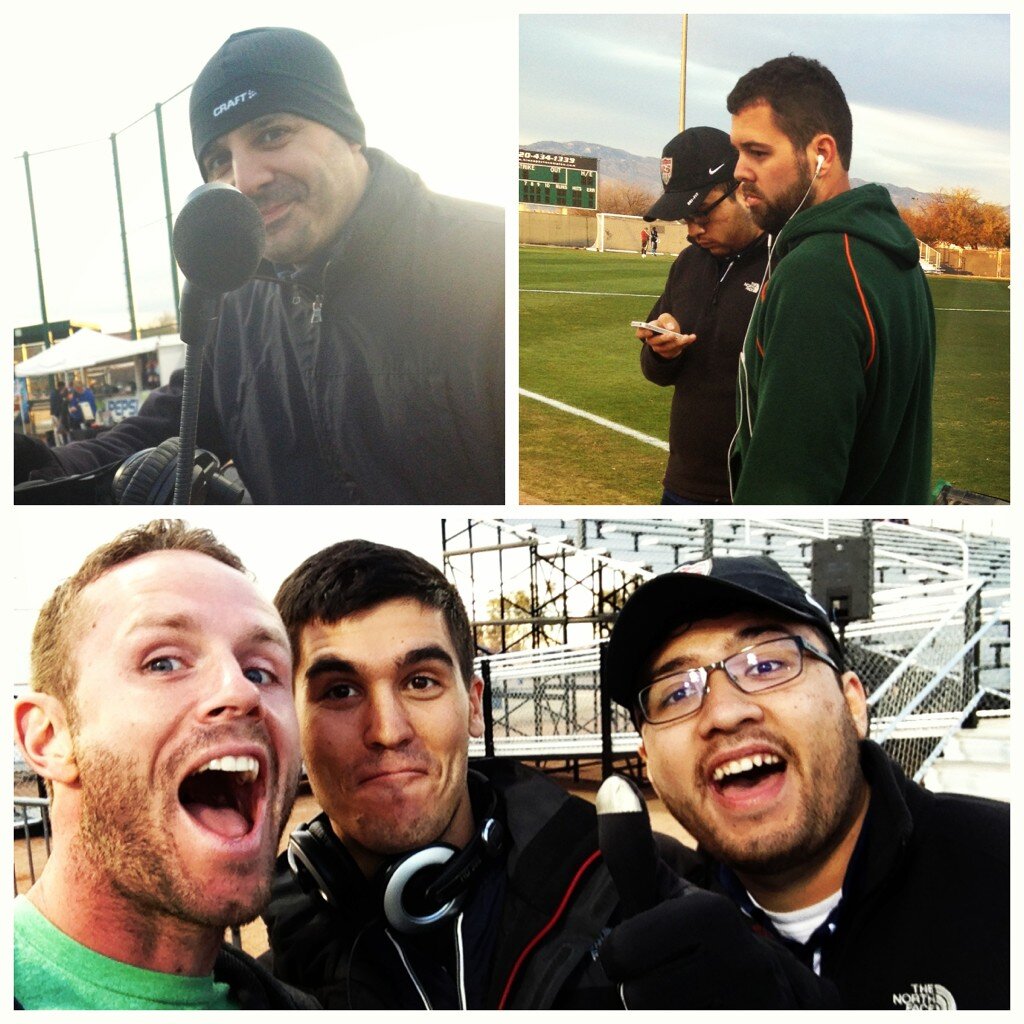
The game production may seem simple compared to a regular-season broadcast, but it takes a lot of people and effort to put together our show. You can see a few of them at the right -- I promise they don't always look like that. Luckily, most of these guys worked three games on Tuesday, so they felt like a single game was easy pickings.

My broadcast partner, MLS 'Armchair Analyst' Matt Doyle, conducted interviews with players and coaches from Houston and San Jose during the day, so I tagged along and tried to pick up whatever behind-the-scenes information I could. We got an early tip on an injury to Houston goalkeeper Tyler Deric and got a better idea of San Jose's roster situation, while also hearing MLS veterans talk about some of the league's top players. Hearing the near-universal praise for Landon Donovan is always really impressive - he is pretty much universally accepted as the best player in MLS history, and with good reason.

On to the game itself. Our hotel managed to totally screw up all my printing options, so my carefully prepared notes on players from both teams - especially important in a pre-season game with many non-roster players - never got printed. To make matters worse, when I got to the stadium, I was told the internet line we were using to stream the games had been cut off. Not exactly a perfect start!

But the internet situation got cleared up, I found time to at least write down lineups and numbers, and we were off. It's a bit weird calling a game from a really low position - on a platform maybe 35 yards off one end line - while the camera angle the viewers are seeing is the preferred high-middle shot. But we had a lot of fun with the show, sharing some trivia and banter and reacting to Twitter comments in addition to calling the game and talking lineups and trialists. Four more games to come this week from Tucson!