25 November 2012

What a basketball debut!


I got a thriller Saturday night in my first ESPN3 college basketball game, as the College of Charleston shocked 24th-ranked Baylor 63-59 in Waco. I really enjoyed the broadcast alongside former DePaul standout and NBA veteran Stephen Howard, and I walked out of the Ferrell Center both exhilarated and satisfied.

The workday started with team shootarounds in the early afternoon, and they were even more helpful than I anticipated. Charleston went first, and we watched from the side with Director of Athletics Communications Marlene Navor and the radio crew of Jeff McCarragher and Everett German. Our familiarity with them would pay off later.

On the Baylor side, the big story was that sharp-shooting guard Brady Heslip would miss the game while recovering from appendicitis. We found this out at the shootaround, but we could not get anybody from Baylor to confirm it on the record, even though we tried right up to tip-off. Of course, much to our frustration, it ended up in the Associated Press recap of the game, so it was definitely not a secret.

We returned to the Ferrell Center for a late-ish tip-off, and despite my (needless) search for a proper credential and Stephen's (fruitless) search for a functional pen, we were ready to go in plenty of time. That was in stark contrast to Baylor radio announcer John Morris, who made a mad dash from the Bears' football game in Arlington, Texas, back to Waco in time for the game. That's what I call a full day!

The game itself was fascinating - Charleston rained 3-pointers early and led at the half, then survived Baylor's revved-up defense in the second half despite getting just one point from leader Andrew Lawrence. He instead turned provider, setting up teammate after teammate for key baskets. The Cougars had six of their eight players contribute at least eight points, and sophomore center Adjehi Baru hauled in 15 rebounds. The key man was his frontcourt partner Willis Hall, who went 8-for-10 from the free-throw line (his teammates were 4-for-10) and hit his only two field goals in the final minutes for the 63-59 win.

Up close and personal, shortly before tip-off.
Behind the scenes, basketball moves so fast that there were some great efforts to aid the broadcast and keep us on top of things. We got an outstanding performance from our statistician on this day, Jeff, who provided helpful notes all game and constantly helped me keep track of individuals' foul trouble. His biggest play, however, came when No. 13 checked in for Baylor. This player was not listed on the roster and had no last name on his jersey; luckily, Jeff knows the program and alerted us that it was freshman Taurean Prince wearing a different uniform, and we were able to introduce him quickly and pass that on to the CofC radio crew.

Finally, as we got into the final five minutes with College of Charleston still in the game, I used my phone to email Charleston's Navor, who was sitting diagonally across the court from us, and I asked her for the date of Charleston's last win against a Top-25 team. I had noticed earlier that the season (2009-10) and opponent (North Carolina) were in the notes, but not the exact date. I never figured it would come into play! I could see Navor across the court, rifling through records, but I was still worried she hadn't gotten the message. In the final minute, my phone finally buzzed with the crucial email, telling us the exact date (Jan. 4, 2010) and the fact that this win was only Charleston's second ever on the road against a Top-25 team and first since 1993. I let Jeff relay the message to the graphics crew, and we were able to get it on the air at the final buzzer. Perfect execution!

Stephen even has a height advantage in post-game interviews.
After we went off-air, Stephen interviewed Doug Wojcik to provide material for the ESPN family of network, and we also filmed a web segment that you can see here. We actually shot a second take that was a little smoother, but the one currently online is our first effort.

Basketball never ceases to make me feel short.
All in all, I really enjoyed my first basketball game of the year and hope it leads to a few more here and there. I'll definitely be keeping an eye on Baylor and College of Charleston as the season heats up. It'll be back to football next Saturday, though, with a little bit of soccer thrown in during the week. I'm very thankful to be this busy.

18 November 2012

Great day of college football

Getting set up in Lafayette.
I'm feeling good tonight after Forrest Conoly and I called Louisiana-Lafayette's come-from-behind win over Western Kentucky at Cajun Field in Lafayette. Good broadcast, good game, and we got to watch the entertaining end of the two big upsets at dinner afterward. How can you argue with a day like that?

This was our second trip to Cajun Field and our third broadcast of the Ragin' Cajuns, while we were seeing Western Kentucky for the first time. Still, I felt through research and talking to coaches from both teams, we had a good handle on both teams. It was nice to see some familiar faces before the game, and the staff from both sides did a good job of preparing us for a few things - Louisiana-Lafayette's black jerseys, some WKU lineup changes, etc.

Nobody warned me about the details of the Cajuns' black jerseys, however! They had a giant fleur de lis on the front, rather than numbers, which is a nightmare for broadcasters. There were mini numbers on the front up by the shoulder pads, but seeing those from a camera well is virtually impossible. It created a few challenges. The jerseys also had French words on the name plate, so I did my best to translate them on the fly. I got combattre (to fight), croire (to believe), and unité (unity), but I wasn't sure on fierté, which turned out to be pride. My bad.

Our open airs shortly before kickoff.
The open is the part of the broadcast where the focus is most on us as hosts. We're on camera and we're singling out storylines, rather than taking from what the game gives us. So naturally we take some pride in putting together something presentable. Our open wasn't 100-percent flawless, but it was definitely the best we've done this year. We ran through it once to get an idea of timing of graphics, and then we knocked it out. We laughed and had fun with some nicknames (Forrest dubbed UL receiver Harry Peoples "The Peoples Choice," which we used throughout the game) and, hopefully, established the game as a battle for bowl positioning. I said "blocked field goal" instead of "blocked punt" in reference to the Ragin' Cajuns' loss last week to Florida, but otherwise I thought we got our facts straight.

The game lived up to our expectations, with Western Kentucky controlling the ball through its dominant ground game and tailback Antonio Andrews (300+ all-purpose yards for the third straight game, leads the country.) Louisiana-Lafayette was effective too, largely thanks to the versatility of quarterback Terrance Broadway, but it looked like four turnovers would undo them. Leading by three late in the game, WKU elected to punt and pin Louisiana-Lafayette in its own end rather than go for it on 4th-and-1, which seemed uncharacteristic for head coach Willie Taggart. Seemed like a decent move when the punt was downed at the 7, but Broadway led the Ragin' Cajuns on a dramatic drive and scored the go-ahead touchdown on a quarterback draw in the final minute. (ESPN video)

A good night to work in college football.
That was exciting enough to call, with Cajun Field going nuts - the crowd noise in our headsets was crazy! But then Western Kentucky got into position for a pretty decent Hail Mary, but it was at the back of the end zone, and the receiver (actually the starting safety) was ruled out of bounds. WKU asked for a replay review, but for some reason it never came, and the only angle we saw was, unfortunately, not very clear.

A dramatic night and two teams that are very fun to call - I'll be rooting for them down the road.

09 November 2012

MLS Cup Playoffs Best 11 (+7) so far

My apologies for the lack of posts - I've doing some mix of working and procrastinating, and I'll leave you to determine which has won out. I've also been watching as much of the MLS Cup playoffs as possible and have enjoyed the ridiculous drama, even though I'm often watching on delay and could simply open a new tab to find out who won.

Rather than a whole, long, drawn-out, "I told you so," I'll just point out that one team will have a huge competitive advantage in the MLS Cup final (home field) based on a difference of five points or fewer over its opponent, one which may have played a more difficult regular-season schedule. As long as that schedule is unbalanced and the final is a single game, I believe it must be played at a neutral site, purely for competitive reasons.

But I digress.

Today, just for fun, I'm picking a Best 11 from the first 10 playoff games of 2012. Why? Because I want to inspire an official all-tournament team for the MLS Cup Playoffs. It's gotta start somewhere, right? Unlike most Best 11s, I will use the Arabic numeral 11, rather than the Roman numeral XI. And unlike most Best 11s, I will choose a starting lineup with players in their actual positions. Groundbreaking, I know. OK, here we go:

MLS Cup Playoffs Best 11 (+7) (conference semifinals and knockout round games only)
GK - Nick Rimando, Real Salt Lake - I'm actually not a huge Rimando fan, because I prefer a 6-foot-plus goalkeeper who can control the penalty area, but a shutout with a broken nose and that exceptional save on Brad Evans early in the second half Thursday night make him a must-choose. Honorable mention to Michael Gspurning and Tally Hall.
RB - Robbie Russell, D.C. United - I know he only played one game, but it was a great game, and all the other right backs who played both games did very little. Seriously, count them. Sarkodie, Myers, Franklin, Beitashour, Lade, Johansson, Beltran. I really like some of those players, but Russell's 90 minutes stood out more than their 180.
CB - Omar Gonzalez, LA Galaxy - This guy is a giant. Not only that, he's really good. If LA wins the title, people will complain about how low a seed they were, but LA was 7-2-3 during the regular season when Gonzalez started, and he was excellent against Wondo and Lenhart. How many center backs were secretly pleased when he elbowed Lenhart in the face?
CB - Jeff Parke, Seattle Sounders - The Sounders didn't allow a goal in 180 minutes against a very good team, and while some of that is on RSL's pathetic execution in the final third (they finished the year being shut out in their last five games), Seattle's defense has to get credit, and Parke's the man for that. Honorable, honorable mention to Bobby Boswell.
LB - Seth Sinovic, Sporting KC - I know, I know, you think I'm picking a defender just because he scored a goal, but really I'm going with Sinovic because Boniek Garcia was relatively quiet in both legs for Houston, none of the Dynamo goals came on Sinovic's side, AND he was the only KC player to find the net. With a diving header. Hard to beat. Honorable mention to Corey Ashe, who was outstanding in the knockout round against Chicago.
RM - Landon Donovan, LA Galaxy - This is tricky, because he did play forward in this series, but I thought this was the best spot for him. He silenced a lot of doubts with a two-assist performance on Wednesday, and I never pick against Landon in the playoffs.
CM - Osvaldo Alonso, Seattle Sounders - This guy works his butt off, and even though it seemed like he was fouling Javier Morales every five minutes in last night's game, the Sounders rarely got pulled out of position against RSL's very tough midfield, and he deserves a lot of the credit. Honorable mention to his partner in crime, Brad Evans.
CM - Ricardo Clark, Houston Dynamo - He has been everywhere in the Dynamo's three playoff games, sliding to break up a play and set up the game-winning goal against Chicago before frustrating Roger Espinoza in Houston last week. His range has reminded everybody of why Dom Kinnear's 4-4-2 was so successful from 2005-09.
LM - Mike Magee, LA Galaxy - All he does is score big playoff goals. And occasionally play goalkeeper really well. But really, it's the clinical playoff goals that put him here. Honorable mention to Nick DeLeon.
FW - Robbie Keane, LA Galaxy - Duh. I enjoy disagreeing with statements made by Bruce Arena (he wants you to disagree with most of them), but when he praises Keane as the best player in the league this year, you can't really argue. Especially when Thierry Henry won't take a last-minute free kick with his team down a goal in a playoff series.
FW - Will Bruin, Houston Dynamo - Clinical, clinical finishes. Three of them. Two of which are not the type usually scored by Houston forward. Easy choice here. Honorable mention to his wingman, Calen Carr.

Bench (these players were actually used as replacements in the postseason)
GK - Joe Willis, D.C. United - If he can come off the bench and save a PK, it's good enough for me. Might be better than Bill Hamid right now anyway. He's definitely more composed.
CB - Andre Hainault, Houston Dynamo - He had really struggled in the second half of the year (and he was on the field for Honduras 8-1 Canada), but he looked confident and competent when called upon against KC.
CB - Tommy Meyer, LA Galaxy - I'm cheating a bit here, but the guy had only started 4 MLS games since May, so I don't consider him a full-time starter.
DF/MF - Lewis Neal, D.C. United - Surprise under-the-radar pick-up who helped Orlando City to USL title last year. Makes you want to promote them straight to MLS, doesn't it?
MF - Oriol Rosell, Sporting KC - He got to play with lower-than-usual pressure because of the situation, but I was impressed with his composure and ability to keep things simple from that deep-lying midfield slot.
MF - Mario Martinez, Seattle Sounders - Yes, I'm picking him just because of his one, series-winning shot. It was that good.
FW - Alan Gordon, San Jose Earthquakes - Goonies never say die. Even when they sprain an ankle.

22 October 2012

My TV soccer season in the books

With the 3-1 FC Dallas loss to Seattle last night, my soccer broadcasting season came to an end. It was my first year working primarily (and, as it turned out, exclusively) on television, and my first year as a free-lance broadcaster rather than as a full-time team employee. As such, there were a lot of changes to get used to and adjustments to make throughout the year.

In the end, I worked 20 soccer games – 8 preseason, 12 regular season – with eight different partners in three different roles for productions by four different clubs and broadcasts on up to eight different outlets, depending on how you count it. To simplify, I called the preseason Disney Pro Soccer Classic (with a one-game cameo as a color analyst) and 10 regular-season FC Dallas games, adding one game of play-by-play for Houston and one game as a sideline reporter for Kansas City. Full schedule.

I fulfilled a major goal – earning a living (or something close to it) as a broadcaster, rather than as a communications professional who broadcasts – and owe a lot of people, both personally and professionally, for their respective roles in that.

The most memorable moment of the season was definitely Julian de Guzman’s dramatic goal against Vancouver on September 15:

I’ve had the pleasure to call some clutch late goals, both for and against my employer, since my first pro soccer broadcast in 2008, and this was one of the most fun. It was an important goal, the timing last-gasp, and the quality of the goal (how I wish we had an end-zone view of it!) satisfied the hopes of an electric crowd. That’s just about everything you can ask for. Comparing it against other plays, it loses a little bit of luster because the playoff chase went unrewarded, but anybody there that night will not soon forget it.

One of my other favorite calls from the season, one that may have flown under the radar, was this Bryan Meredith save against FC Dallas on May 9:
The play was a great one, but I felt the whole call worked well. I was able to transition from a separate point (Seattle fatigue) into the play via Fabian Castillo, I correctly identified Andrew Jacobson as the player who headed it back, and “Oh, what a stop!” felt like a good reaction to the play. After the play stopped, I was able to sum it up before turning it over to Ian Joy for the replay (which happened to come from my favorite angle).

I also really enjoyed my one foray as a sideline reporter, working for Kansas City in a June game in Philadelphia, but unfortunately all video evidence of that night seems to be lost. Kansas City fans were understandably quick to jettison any DVR recordings of their 4-0 defeat, and as far as I know, only the Philadelphia broadcast of the game still exists.

Looking back, I think the biggest improvement I made over the course of the season was ramping up the energy on my broadcasts. That applies mostly to on-camera segments, but also to play-by-play. I’m a low-key guy by nature, so I don’t like to get worked up until a moment really calls for it, but I am always excited to be calling a game. On camera, however, it sometimes takes a little bit of effort to make sure that excitement impacts the viewer. I think opening segments and slow moments in the game sounded much better in May, July, September, and October than they did in March and April. That change really started with some feedback from do-it-all analyst Brian Dunseth, so my thanks to him for that honest, helpful critique.

Overall, I felt good about my debut season on television. I would have loved to call a game every weekend and call some playoff games, but I got more comfortable each game and got better as the year went on, and that’s what you hope for. I’m excited to watch the MLS postseason and even more excited to call MLS games next year, hopefully as early as February or March.

20 October 2012

You know you're in Texas when ...

It's game day in San Antonio, and as if Forrest and I needed another reminder, our hotel breakfast let us know exactly which state we are in.

We went to the UTSA walk-through yesterday afternoon and were very impressed with the Alamodome - looking forward to seeing and hearing the crowd this afternoon.

To get ready for today's game, which you can watch on ESPN3 and discuss on Twitter with the hashtag #SJSUvsUTSA, you can also check out today's articles from the local papers:

San Antonio Express-News:   Preview  |  Keys to Victory  |  Key Matchups  |  Player Spotlight
San Jose Mercury-News:   Preview  |  Game Facts

Kickoff is 1 p.m. Central Time - check it out!

19 October 2012

Big questions face UTSA, San Jose State

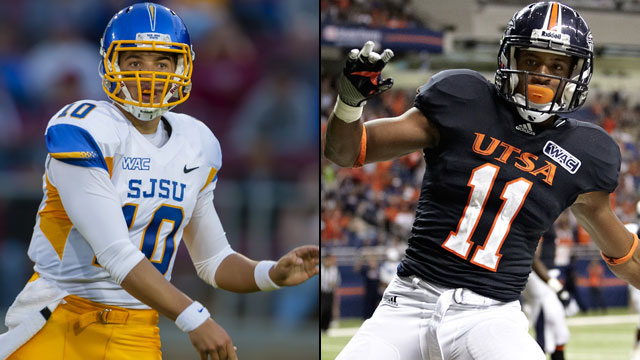
San Jose State QB David Fales and UTSA RB David Glasco
square off Saturday.
This weekend, I’m headed to San Antonio for some college football, covering UTSA against San Jose State for ESPN3. It’s Homecoming and the first home conference game for UTSA, which is in its first year of a two-year transition to the FBS level. As such, the Roadrunners’ 5-1 record is a bit misleading; they are 2-1 against FBS opponents, including South Alabama, which is in its second year of the same two-year transition. San Jose State entered conference play as a title contender along with favorite Louisiana Tech and Utah State, but a lopsided loss to Utah State last week dampened the Spartans’ confidence somewhat.

I’ll be working the game with former Florida State offensive lineman Forrest Conoly, a familiar face by now, and we spent some time this week on the phone with both coaching staffs. There are a lot of matchups and sub-plots to keep an eye on, but here are the two biggest questions of the game:

Can San Jose State’s offense bounce back?
San Jose State was sacked 13 times last week. 13! That’s only two shy of the NCAA record. Nobody expects UTSA to duplicate that effort; the Roadrunners’ defensive front is nowhere near the equal of Utah State’s, and San Jose State will definitely make some adjustments. But UTSA is going to have to get pressure on Spartan quarterback David Fales, a junior college transfer with an almost unerringly accurate arm. If Fales is forced to move in the pocket, it could disrupt his throws enough to keep UTSA in the game. San Jose State will also try to take some pressure off Fales and his receivers by running the ball – after all, Rice ran for 301 yards against the Roadrunners last week – and the UTSA defense will likely need to continue producing turnovers to win the game.

Can UTSA win without a full-strength Eric Soza?
Roadrunners quarterback Eric Soza scored the first touchdown in program history, has started every game, and rarely misses a snap. Any discussion of team leaders starts with him. So when he jogged to the locker room with a hip injury late in the first half last week, it was a troublesome sign. He returned to play the second half and practiced this week, but he is still a question mark for Saturday and will not be at 100 percent even if he does play. It is asking a lot of UTSA, which is probably outmanned on pure talent, to win without him or with him at less than 100 percent. If he cannot go, redshirt freshman Ryan Polite should get the call; he looked good on two drives against Rice. How the possibly hampered Soza or the inexperienced Polite performs will be the first make-or-break challenge facing UTSA.

Players to watch
San Jose State
10 David Fales, QB 162-316, 1,867 yards, 12 TDs, 3 INTs
Coaches on both sides rave about his accuracy, capable of squeezing throws into tight spaces, and Fales has talented receivers to make it pay off. He struggled to get rid of the ball quickly, however, against Utah State's fearsome pass rush.
43 Travis Johnson, DE 39 tackles, 13.5 tackles for loss, 7.5 sacks
As consistent as they come, Johnson continues to get into opposing backfield despite facing regular double-teams. He's tied for the national lead with a tackle for loss in 12 consecutive games, and he is the only player from a non-BCS school to be one of 25 quarterfinalists for the Rotary Lombardi Award.

UTSA
1 Kam Jones, WR 12 receptions, 205 yards, 1 TD
Forrest always likes to ask about a 'wild guy,' and Jones is it. A former high school quarterback from small town Edna, Texas, Jones can catch, run, and throw from his wide receiver spot. He hasn't scored since the season opener, but he's the offensive playmaker.
17 Erik Brown, CB 16 tackles, 4 interceptions, 1 forced fumble in 5 games
Brown was a high school star at local power Converse Judson, but finished high school in Arizona and began his college career at Fresno State. Back home in Texas, he is responsible for five of UTSA's 17 forced turnovers and a key player in a secondary that faces a stiff test on Saturday.

30 September 2012

Fun with nicknames

Cajun Field prior to kickoff.
We had some fun with nicknames on our ESPN3 college football broadcast Saturday night, as I covered Louisiana-Lafayette against FIU, teamed with my first repeat partner of the football season, one Mr. Forrest Conoly. We used nicknames or variations for several players on the broadcast, but it actually all started earlier in the day.

Before every game, the analyst provides ‘Keys to the Game,’ one of those segments you see on just about every broadcast. To keep it from being too straightforward and clichéd, the production staff often tries to use puns or wordplay in the on-screen graphic, counting on the announcer to explain its meaning.

For this game, Forrest and I met with our producer in the afternoon at one of the hotels. It had poured the night before, was raining again, and the forecast called for scattered thunderstorms throughout the night. We figured throwing the ball could be tough, so the ground game would be important, and Louisiana-Lafayette uses a two-back system, rotating a bigger back (Alonzo Harris) with a quicker back (Effrem Reed). We didn’t want to put ‘run the ball’ on the graphic, so we looked out the window, and quickly arrived at a(n admittedly clichéd) moniker: ‘Thunder and Lightning.’ This has been used for countless running back duos, so it is not at all original, but we liked the double entendre referencing both their running styles and the weather.

Once the game began, Forrest of course explained his keys to the game – “That’s Alonzo Harris and his ability to be a powerful runner, as well as Effrem Reed and his scatback ability to get to the outside and get those corners” and later elaborated further – but I don’t know if fans got the second meaning, given that there was no literal rain, thunder, or lightning during the game. At any rate, we had fun with it, and Forrest would occasionally call them simply ‘Thunder’ or ‘Lightning’ while analyzing a replay. I, the straight man, used their names while calling play-by-play.

But I had to have some fun when the Ragin’ Cajuns went to seldom-used wide receiver Bradley Brown, a transfer from Northwestern State in his first year at the FBS level. While doing research for my first Louisiana-Lafayette game, I had learned that his high school nickname was ‘Downtown,’ courtesy of an article at theGaiterView.com. This developed in my head into a rhythmic ‘Downtown Bradley Brown,’ vaguely reminiscent of the Jim Croce song ‘Bad, Bad Leroy Brown.’

So when Brown got into the game late in the first quarter and made a big catch, I couldn’t resist saying, “Bradley Brown – they call him ‘Downtown Bradley Brown’ –with the first-down catch.” I figured that was all I would get out of it. But two plays later, Cajuns quarterback Blaine Gautier found Brown in a lot of space, and I had my chance to use it live: “Catch is made by Brown, and he’s going downtown!” He couldn't quite finish the play, as two FIU defensive backs were able to pull him down inside the 20-yard line, but it was definitely a fun one to call. If that nickname ever started to wear off, hopefully this helps him bring it back!

I also made a few puns with UL quarterback Terrance Broadway, the unquestioned star of the game after passing for 228 yards and one touchdown and running for 28 yards and two more scores. I don’t think I’m the first to make a ‘Broadway’ joke, and I’m sure I won’t be the last (especially with the unfortunate news that starting QB Blaine Gautier will be out at least four weeks with broken bones in his throwing hand.)

Anyway, those are some of the nicknames we dropped on the broadcast, the last one we have scheduled with ESPN3 at the moment. We’re a bit of a size mismatch for on-camera portions of the broadcast (Forrest is 6-foot-7, I’m somewhere in the 5-11/6-0 range), but I think we complement each other well in most other aspects and, most importantly, we enjoy working together. Hopefully we get the chance to do some more games this year, maybe even involving Louisiana-Lafayette. After all, the Cajuns are 2-0 when we call the shots.

28 September 2012

Why all of the final CCL matches matter

Houston could play the second leg of a quarterfinal at
BBVA Compass Stadium, depending on goal differential
The group stage of the CONCACAF Champions League - contested for the first time in eight groups of three - is down to one remaining round of matches, to be played October 23-25. Three teams have clinched their spots in the quarterfinals, but even those three teams need to be on their game next month. Here's why.

One of the changes to the competition is that matchups in the quarterfinals (and beyond) are now determined by performance in the group stage, rather than by random draw. This is an underrated move by CONCACAF, in my opinion. Yes, the teams are being compared against unequal opponents; is it really fair to reward teams that go 4-0 against a group that included a Caribbean or weak Central American opponent? But the move is worth that question because (a) it legitimizes a competition that sometimes seemed to be fixed to get at least one American team to the semifinals and (b) it makes every minute of the group stage count.

Seeding in the knockout round is very important, because the higher seed gets the second leg at home, usually a big advantage. This is far from the only reason Mexican clubs have dominated American ones in head-to-head competition, but the second leg has been in Mexico more often than not. This time, they'll have to earn it.

So here's how the race for home-field advantage in the elimination round shapes up. Projected seeds are how I think the teams will finish, not their current spot:


Proj SeedTeamRecordGDLast Game
(Almost) clinched
1Santos Laguna3-0+1110/24 vs. Toronto
ORToronto FC2-1+510/24 at Santos Laguna
2Monterrey3-0+910/23 at Chorrillo
3Seattle Sounders3-0+510/24 vs. Marathon
4LA Galaxy2-0-1+710/25 at Metapan
Battling it out
5Houston Dynamo2-0-1+610/23 vs. Olimpia
OROlimpia1-1-1+210/23 at Houston
6Real Salt Lake2-1+210/23 vs. Herediano
ORHerediano3-0+310/23 at Real Salt Lake
7Tigres1-0-2+410/24 vs. Alajuelense
ORAlajuelense2-0-1+410/24 at Tigres
8Chivas1-1-1+310/25 vs. Xelaju
ORXelaju2-0-1+210/25 at Chivas

Head-to-head matchups will determine the final five spots (CONCACAF may have a history of corruption, but the people running do not miss a chance for drama, pairing two powers in the final match of each group), but you can see where this is going. If the home teams prevail with the results they need, we'll get the Mexican/U.S. quarterfinals, but the matchups would play out to something like this:

1. Santos Laguna vs. 8 Chivas Guadalajara
2. Monterrey vs. 7 Tigres
3. Seattle Sounders vs. 6 Real Salt Lake
4. LA Galaxy vs. 5 Houston Dynamo

Of course, that's taking a lot for granted. Five teams still need to take care of business just to advance. But the point is that they need to focus not just on doing enough to advance; they need to be worried about their quarterfinal seed. Santos cannot afford to tie Toronto at home; a win would secure them the top seed. Seattle cannot afford to be on cruise control against Marathon; they have an outside chance of catching Monterrey for the all-important No. 2 seed, which could give them a home game in the semifinals.

Real Salt Lake, Tigres, and Chivas will all be trying just to get the win that will send them to the quarterfinals (RSL needs to win 1-0 or by multiple goals), and Houston needs just a tie at home against Olimpia. Given its precarious MLS playoff position, the Dynamo will probably put out a mixed squad, but winning and tacking on a few goals should still be a priority in an attempt to wrest the second leg of a potential quarterfinal matchup away from recent rival LA. After all, Houston's last two playoff outings have ended at The Home Depot Center.

The new format of the Champions League has its positives and negatives, but there is something to play for in all eight of the final matches, and we could be in store for the most storied quarterfinalists in the tournament's short history.

22 September 2012

An Obama sighting in ... Texas?

Dan McCarney addresses the Mean Green Friday.
I haven't had time to blog about my game this weekend, North Texas vs. Troy, but it's not because I haven't been preparing for it. I arrived in Denton on Friday afternoon and quickly headed to highly-regarded Apogee Stadium, which opened last year, for the Mean Green's walk-through. I ended up seeing a more than credible impersonation of President Barack Obama, about the last thing I expected to find in Texas, as part of the North Texas post-game speeches.

The impersonation came from actor Aaron Norvell, who played under Dan McCarney at Wisconsin in the early 90s and was one of two of McCarney's former players invited to speak to North Texas following its light workout. As McCarney put it, "I don't let anybody speak to this team unless they're special, I love them, or both," and it was a nice way to close the afternoon.

In terms of the game, it's a great "battle of philosophies," as Troy head coach (and Friday birthday boy) Larry Blakeney put it, between Troy's wide-open, up-tempo aerial attack (537.7 yards per game) and the battering, physical, ball-possession approach favored by North Texas. To put it in perspective, Troy threw more passes in one game this year (75 against Louisiana-Lafayette) than North Texas has all season (73). Both teams, former conference powerhouses, badly need a win to get into the Sun Belt Conference title race.

The real key to the game, though, will be turnovers. Troy is an abysmal -5 on the season, including turnovers on four straight possessions against Mississippi State last week - the Trojans wound up losing by one score. North Texas is +3, and I think the Mean Green will have to win the turnover battle again to open the year with a win.

Apogee Stadium, opened 2011.
For more on the game, check out the excellent blogs by the teams' respective beat-writers, outgoing Drew Champlin (Dothan Eagle) and  Brett Vito (Denton Record-Chronicle).

Tonight's game kicks off at 6 p.m. CT on ESPN3 and WatchESPN. Follow @jtyardley for more coverage before and after the game.