While in North Dakota, I had the chance to take in an amazing atmosphere at a University of North Dakota hockey game. While on an airplane a day and a half later, I took a stab at an essay on the topic. It's not my usual style or subject matter on this blog, but what is a free-lance blog for if not posting stories that you haven't been able to sell to anybody!?
So if you're interested, check it out after the jump. It was a fun night.
-----
13 December 2012


12 December 2012
MLS home-grown prospect update
The MLS offseason has a number of different sub-plots, and one of my favorites is collegiate soccer players with the potential to be signed to home-grown contracts. It’s early in December, but we’re already getting news on the home-grown player front. Between the NCAA College Cup and the initial list of players invited to January’s MLS Combine, we’re getting a good idea of which senior prospects could be signing directly with a club, rather than hoping to be picked in the SuperDraft. (Underclassmen, of course, are another story.)
I was a little surprised to hear so much talk about the draft prospects of Georgetown midfielder Ian Christianson (a senior) and Maryland forward Patrick Mullins (a junior) during the College Cup, given that both were claimed by the Fire on a 2010 list of home-grown claims. That list had yet to be ratified by MLS, however, and claims from a variety of teams later fell through. So I’ve been curious about the specific cases of Christianson and Mullins, and I think I now have answers:
Christianson
It seems that Christianson played for the Chicago Fire Academy in his junior and senior years of high school and then went to Georgetown. Where the situation gets tricky, however, is the fact that Christianson’s hometown of Cedar Rapids, Iowa, is a good 220 miles from Bridgeview, much greater than the maximum of 75 miles allowed by the Fire’s specified home territory. Based on the original MLS home-grown player rules, which could have been changed by now, teams were allowed two territorial exemptions (players who live outside the home territory) per age group (there were six age groups at the time; the rules contain no explanation of what happens when a territorial exemption moves up an age group).
MLSsoccer.com’s Daniel Robertson reported on Sunday that Christianson said his lack of home-grown eligibility was a decision made by MLS, but Fire Director of Communications Brendan Hannan said in an e-mail that Christianson was not on the club’s home-grown list because, “the club is left with difficult decisions on who to place on the ‘out of area’ home-grown list.” Reading between the lines, the Fire must have (either now, or at some point during Christianson’s association with the club) decided to prioritize two other prospects from outside the home territory.
Mullins
This is an interesting one. Mullins played youth soccer in Louisiana for Lafreniere SC, one of several clubs that merged to form the Chicago Fire Juniors Louisiana club. Hannan's email said, however, that Mullins had left for college before his club’s official affiliation with the Fire.
Normally this would be understandably clear-cut, but the decision not to accept the Fire’s claim to Mullins (a claim they did make as far back as 2010, and he has since played for Fire U-20 teams) seems to contradict a recent MLS precedent. Last year, MLS accepted the Portland Timbers’ home-grown claim to forward Brent Richards, who played youth soccer for EastSide United way before the MLS Timbers even existed and also played for the Timbers’ PDL team. EastSide United was later folded into the MLS Timbers’ youth system, providing the basis for Richards’ signing. In a somewhat similar situation, I have heard that the San Jose Earthquakes will be able to place a home-grown claim on former U.S. U-17 and current Santa Clara goalkeeper Kendall McIntosh, even though he left for U-17 residency before his club became affiliated with the Earthquakes. This is likely a few years away, but worth noting.
We don’t know how much back-and-forth there was between MLS and the Fire over these two players, but it is interesting to track some of these borderline cases. Believe me, there are a lot more behind the scenes that we don’t hear about.
As for home-grown MLS prospects, here is a summary of what is being reported about some of those already linked to pro deals for 2013, notably from Adam Jardy at the Columbus Dispatch and Ives Galarcep of Soccer By Ives:
Just for fun, here are some other players who could be looking at pro contract offers, even though I haven't seen it reported:
I was a little surprised to hear so much talk about the draft prospects of Georgetown midfielder Ian Christianson (a senior) and Maryland forward Patrick Mullins (a junior) during the College Cup, given that both were claimed by the Fire on a 2010 list of home-grown claims. That list had yet to be ratified by MLS, however, and claims from a variety of teams later fell through. So I’ve been curious about the specific cases of Christianson and Mullins, and I think I now have answers:
Christianson
It seems that Christianson played for the Chicago Fire Academy in his junior and senior years of high school and then went to Georgetown. Where the situation gets tricky, however, is the fact that Christianson’s hometown of Cedar Rapids, Iowa, is a good 220 miles from Bridgeview, much greater than the maximum of 75 miles allowed by the Fire’s specified home territory. Based on the original MLS home-grown player rules, which could have been changed by now, teams were allowed two territorial exemptions (players who live outside the home territory) per age group (there were six age groups at the time; the rules contain no explanation of what happens when a territorial exemption moves up an age group).
MLSsoccer.com’s Daniel Robertson reported on Sunday that Christianson said his lack of home-grown eligibility was a decision made by MLS, but Fire Director of Communications Brendan Hannan said in an e-mail that Christianson was not on the club’s home-grown list because, “the club is left with difficult decisions on who to place on the ‘out of area’ home-grown list.” Reading between the lines, the Fire must have (either now, or at some point during Christianson’s association with the club) decided to prioritize two other prospects from outside the home territory.
Mullins
This is an interesting one. Mullins played youth soccer in Louisiana for Lafreniere SC, one of several clubs that merged to form the Chicago Fire Juniors Louisiana club. Hannan's email said, however, that Mullins had left for college before his club’s official affiliation with the Fire.
Normally this would be understandably clear-cut, but the decision not to accept the Fire’s claim to Mullins (a claim they did make as far back as 2010, and he has since played for Fire U-20 teams) seems to contradict a recent MLS precedent. Last year, MLS accepted the Portland Timbers’ home-grown claim to forward Brent Richards, who played youth soccer for EastSide United way before the MLS Timbers even existed and also played for the Timbers’ PDL team. EastSide United was later folded into the MLS Timbers’ youth system, providing the basis for Richards’ signing. In a somewhat similar situation, I have heard that the San Jose Earthquakes will be able to place a home-grown claim on former U.S. U-17 and current Santa Clara goalkeeper Kendall McIntosh, even though he left for U-17 residency before his club became affiliated with the Earthquakes. This is likely a few years away, but worth noting.
We don’t know how much back-and-forth there was between MLS and the Fire over these two players, but it is interesting to track some of these borderline cases. Believe me, there are a lot more behind the scenes that we don’t hear about.
As for home-grown MLS prospects, here is a summary of what is being reported about some of those already linked to pro deals for 2013, notably from Adam Jardy at the Columbus Dispatch and Ives Galarcep of Soccer By Ives:
| MLS club | Player | College | HG claim status | Outlook |
| Chicago | MF Ian Christianson | Georgetown | none | MLS combine |
| Columbus | DF Chad Barson | Akron | accepted | likely to sign |
| Columbus | GK Justin Luthy | Boston College | accepted | likely to sign |
| Columbus | DF Matt Wiet | UCLA | accepted | likely to sign |
| Columbus | MF Wil Trapp | Akron (soph.) | accepted | hired agent, could sign |
| D.C. United | FW Uwem Etuk | West Virginia | club declined | MLS combine |
| FC Dallas | DF London Woodberry | Maryland | accepted | contract offered |
| New England | MF Scott Caldwell | Akron | accepted | likely to sign |
| Portland | FW Erik Hurtado | Santa Clara | denied | MLS combine |
| MLS club | Player | College | Resume |
| Chicago | MF Bryan Ciesiulka | Marquette (jr.) | 2nd tm Big East; 5g, 9a |
| Chicago | MF Harry Shipp | Notre Dame (jr.) | 3rd tm Big East; 6g, 6a |
| Colorado | GK Brendan Roslund | San Francisco (sr.) | 6-foot-6; 0.99 GAA |
| Colorado | DF Patrick Slogic | Cornell (jr.) | 6-foot-5; 1st tm all region |
| Colorado | MF Dillon Serna | Akron (fr.) | 1st tm MAC; 2g, 8a |
| FC Dallas | DF Mikey Ambrose | Maryland (fr.) | 2nd tm ACC; 1g, 7a |
| FC Dallas | MF Danny Garcia | UNC (fr.) | 2nd tm ACC; Frosh POY |
| FC Dallas | DF Boyd Okwuonu | UNC (so.) | 1st tm ACC |
| Houston | DF Sebastien Ibeagha | Duke (jr.) | ACC Def. POY |
| LA Galaxy | FW Gyasi Zardes | CSU-Bakersfield (jr.) | MPSF POY; 15gls in 17gms |
| New York | GK Keith Cardona | Maryland (so.) | 1.14 GAA |
| New York | FW Brandon Allen | Georgetown (fr.) | Big East Rookie of Yr; 16g, 2a |
| Portland (from NY) | MF Bryan Gallego | Akron (so.) | 2nd tm MAC |
| Portland | MF Steven Evans | Portland (jr.) | 1st tm WCC; 14g, 3a |
| Seattle | DF DeAndre Yedlin | Akron (so.) | 1st tm MAC; 6a |
| Seattle | FW Sean Okoli | Wake Forest (so.) | 2nd tm ACC; 11g, 3a |
| Seattle | MF Aaron Kovar | Stanford (fr.) | Pac 12 Frosh of Yr; 3g, 2a |
| Toronto FC | FW Allando Matheson | UConn (so.) | 7g, 1a |
| Vancouver | MF Ben McKendry | New Mexico (fr.) | MPSF Newcomer of Yr |
09 December 2012
Photo blog: My trip to North Dakota
I got the wonderful chance this week to visit North Dakota for the first time, letting me cross another state off my list. Not too many left!
Somewhat fittingly, I ended up getting stuck in Fargo, N.D., for an extra day after my Sunday-morning flight was cancelled, but here's a photo blog from my first two days in this cold, cold state:
Friday was a long, long travel day. Shreveport-Fargo is not exactly a direct flight. It took 10+ hours, three flights, and a roughly 40-degree dip in temperature.
Naturally, my first destination was the Fargodome, capacity somewhere upwards of 18,000.
I met up with my partner, Ben Leber, and some of our crew on Friday night, and by airtime on Saturday, we were ready to go.
The game itself was low-scoring but intense and highly entertaining. Both teams used a lot of clock with every possession, with Wofford trying to upset the defending FCS champion. North Dakota State's dominating defense (no offensive touchdowns allowed in last 14 quarters of playoff football) made crucial third- and fourth-down stops in the fourth quarter to advance to the FCS semifinals next week.
Afterward, a look at the production truck responsible for making us look good.
Since it was a day game and I'm a long-time amateur hockey fan, I took the chance to drive 87 miles up to Grand Forks, N.D. to see the famed Ralph Engelstad Arena at the University of North Dakota. Despite some wind and really poor visibility, I'm very glad I went. The arena and atmosphere, with a sold-out crowd of 11,799, were simply amazing, and it was great to see some live hockey. Great end to a very fun sports day.
Friday was a long, long travel day. Shreveport-Fargo is not exactly a direct flight. It took 10+ hours, three flights, and a roughly 40-degree dip in temperature.
 |
| 7 a.m. flight from Shreveport. |
 |
| Connecting in Denver. |
 |
| 4:30 p.m. arrival in Fargo. |
 |
| NDSU is everywhere in Fargo. |
 |
| The inimitable Fargodome. |
I met up with my partner, Ben Leber, and some of our crew on Friday night, and by airtime on Saturday, we were ready to go.
 |
| Former Vikings LB Ben Leber, a South Dakota native who is well-known and popular in the area. |
 |
| Almost time for kick-off. |
The game itself was low-scoring but intense and highly entertaining. Both teams used a lot of clock with every possession, with Wofford trying to upset the defending FCS champion. North Dakota State's dominating defense (no offensive touchdowns allowed in last 14 quarters of playoff football) made crucial third- and fourth-down stops in the fourth quarter to advance to the FCS semifinals next week.
 |
| Noise level upward of 100 decibels at times during the game, won by NDSU 14-7 behind its top-rated defense. |
Afterward, a look at the production truck responsible for making us look good.
 |
| Behind-the-scenes magic. |
Since it was a day game and I'm a long-time amateur hockey fan, I took the chance to drive 87 miles up to Grand Forks, N.D. to see the famed Ralph Engelstad Arena at the University of North Dakota. Despite some wind and really poor visibility, I'm very glad I went. The arena and atmosphere, with a sold-out crowd of 11,799, were simply amazing, and it was great to see some live hockey. Great end to a very fun sports day.
 |
| Yeah, it was snowing as I got to the arena midway through the first period. |
 |
| As for the game, UND beat Denver 6-3 in WCHA action. |
02 December 2012
Enjoying a different type of football
 |
| Home fans and their distinctive orange at Bowers Stadium in Huntsville, Texas |
So when assigned an FCS college football playoff game last weekend, I was psyched. I watch these games on TV every year and really enjoy the football division formerly known as Division I-AA.
I got the matchup between Sam Houston State, last year’s runner-up, and Cal Poly. Oddly enough, I had already been to both teams’ home stadiums, but neither for a college football game. Throw in a reasonable, three-hour drive from Shreveport to Huntsville, Texas, and my trusty broadcast partner, Forrest Conoly, and I was anticipating a fun afternoon on Saturday.
The broadcast itself had a few more elements than we have had in our other games, including on-camera reporting at halftime, coach interviews, regular promotional reads for other ESPN broadcasts, and more. It sounds like par for the course for a lot of the broadcasts you see, but it is not the norm for us. That takes some getting used to, but it was pretty similar to a lot of the soccer broadcasts I’ve done, so I didn’t feel like we were overwhelmed by some of the moving parts.
We had a great production crew, from the guys in the truck to those manning cameras to the stage managers in the booth with us. While we’re used to working with solid crews, this was probably the best top-to-bottom group we’ve worked with on a football game this year, and it included a few friendly faces I know from Houston.
 |
| Our open aired while it was still light out. |
I got to voice-over the most elaborate tease we’ve had this year – including video of the giant Sam Houston statue – and I thought we did well in the open. The game itself was a little disjointed, and it took us time to get in a rhythm. Both teams came in with great offensive reputations, but they struggled to reach the end zone. The first score of the game was a blocked punt that went for a safety, and that actually ended up being the difference. We did see a cool double-reverse touchdown pass from Cal Poly in the final minutes, but the Mustangs’ onside kick was recovered by Sam Houston State, and the Bearkats are on to the quarterfinals against Montana State.
It may not have been the perfect game or the perfect broadcast, but I really enjoy covering teams and sports that you don’t hear about on every sports talk show. Plus I think it’s great to cover playoff football at the college level, and Saturday’s game definitely had some of that desperate intensity that the playoffs can produce. I’m looking to more of the same next week, in what will probably be my final broadcast of the 2012 calendar year, so stay tuned.
25 November 2012
What a basketball debut!

 I got a thriller Saturday night in my first ESPN3 college basketball game, as the College of Charleston shocked 24th-ranked Baylor 63-59 in Waco. I really enjoyed the broadcast alongside former DePaul standout and NBA veteran Stephen Howard, and I walked out of the Ferrell Center both exhilarated and satisfied.
The workday started with team shootarounds in the early afternoon, and they were even more helpful than I anticipated. Charleston went first, and we watched from the side with Director of Athletics Communications Marlene Navor and the radio crew of Jeff McCarragher and Everett German. Our familiarity with them would pay off later.
On the Baylor side, the big story was that sharp-shooting guard Brady Heslip would miss the game while recovering from appendicitis. We found this out at the shootaround, but we could not get anybody from Baylor to confirm it on the record, even though we tried right up to tip-off. Of course, much to our frustration, it ended up in the Associated Press recap of the game, so it was definitely not a secret.

The game itself was fascinating - Charleston rained 3-pointers early and led at the half, then survived Baylor's revved-up defense in the second half despite getting just one point from leader Andrew Lawrence. He instead turned provider, setting up teammate after teammate for key baskets. The Cougars had six of their eight players contribute at least eight points, and sophomore center Adjehi Baru hauled in 15 rebounds. The key man was his frontcourt partner Willis Hall, who went 8-for-10 from the free-throw line (his teammates were 4-for-10) and hit his only two field goals in the final minutes for the 63-59 win.
 |
| Up close and personal, shortly before tip-off. |
Finally, as we got into the final five minutes with College of Charleston still in the game, I used my phone to email Charleston's Navor, who was sitting diagonally across the court from us, and I asked her for the date of Charleston's last win against a Top-25 team. I had noticed earlier that the season (2009-10) and opponent (North Carolina) were in the notes, but not the exact date. I never figured it would come into play! I could see Navor across the court, rifling through records, but I was still worried she hadn't gotten the message. In the final minute, my phone finally buzzed with the crucial email, telling us the exact date (Jan. 4, 2010) and the fact that this win was only Charleston's second ever on the road against a Top-25 team and first since 1993. I let Jeff relay the message to the graphics crew, and we were able to get it on the air at the final buzzer. Perfect execution!
 |
| Stephen even has a height advantage in post-game interviews. |
 |
| Basketball never ceases to make me feel short. |
18 November 2012
Great day of college football
 |
| Getting set up in Lafayette. |
This was our second trip to Cajun Field and our third broadcast of the Ragin' Cajuns, while we were seeing Western Kentucky for the first time. Still, I felt through research and talking to coaches from both teams, we had a good handle on both teams. It was nice to see some familiar faces before the game, and the staff from both sides did a good job of preparing us for a few things - Louisiana-Lafayette's black jerseys, some WKU lineup changes, etc.
Nobody warned me about the details of the Cajuns' black jerseys, however! They had a giant fleur de lis on the front, rather than numbers, which is a nightmare for broadcasters. There were mini numbers on the front up by the shoulder pads, but seeing those from a camera well is virtually impossible. It created a few challenges. The jerseys also had French words on the name plate, so I did my best to translate them on the fly. I got combattre (to fight), croire (to believe), and unité (unity), but I wasn't sure on fierté, which turned out to be pride. My bad.
 |
| Our open airs shortly before kickoff. |
The game lived up to our expectations, with Western Kentucky controlling the ball through its dominant ground game and tailback Antonio Andrews (300+ all-purpose yards for the third straight game, leads the country.) Louisiana-Lafayette was effective too, largely thanks to the versatility of quarterback Terrance Broadway, but it looked like four turnovers would undo them. Leading by three late in the game, WKU elected to punt and pin Louisiana-Lafayette in its own end rather than go for it on 4th-and-1, which seemed uncharacteristic for head coach Willie Taggart. Seemed like a decent move when the punt was downed at the 7, but Broadway led the Ragin' Cajuns on a dramatic drive and scored the go-ahead touchdown on a quarterback draw in the final minute. (ESPN video)
 |
| A good night to work in college football. |
A dramatic night and two teams that are very fun to call - I'll be rooting for them down the road.
09 November 2012
MLS Cup Playoffs Best 11 (+7) so far
My apologies for the lack of posts - I've doing some mix of working and procrastinating, and I'll leave you to determine which has won out. I've also been watching as much of the MLS Cup playoffs as possible and have enjoyed the ridiculous drama, even though I'm often watching on delay and could simply open a new tab to find out who won.
Rather than a whole, long, drawn-out, "I told you so," I'll just point out that one team will have a huge competitive advantage in the MLS Cup final (home field) based on a difference of five points or fewer over its opponent, one which may have played a more difficult regular-season schedule. As long as that schedule is unbalanced and the final is a single game, I believe it must be played at a neutral site, purely for competitive reasons.
But I digress.
Today, just for fun, I'm picking a Best 11 from the first 10 playoff games of 2012. Why? Because I want to inspire an official all-tournament team for the MLS Cup Playoffs. It's gotta start somewhere, right? Unlike most Best 11s, I will use the Arabic numeral 11, rather than the Roman numeral XI. And unlike most Best 11s, I will choose a starting lineup with players in their actual positions. Groundbreaking, I know. OK, here we go:
MLS Cup Playoffs Best 11 (+7) (conference semifinals and knockout round games only)
GK - Nick Rimando, Real Salt Lake - I'm actually not a huge Rimando fan, because I prefer a 6-foot-plus goalkeeper who can control the penalty area, but a shutout with a broken nose and that exceptional save on Brad Evans early in the second half Thursday night make him a must-choose. Honorable mention to Michael Gspurning and Tally Hall.
RB - Robbie Russell, D.C. United - I know he only played one game, but it was a great game, and all the other right backs who played both games did very little. Seriously, count them. Sarkodie, Myers, Franklin, Beitashour, Lade, Johansson, Beltran. I really like some of those players, but Russell's 90 minutes stood out more than their 180.
CB - Omar Gonzalez, LA Galaxy - This guy is a giant. Not only that, he's really good. If LA wins the title, people will complain about how low a seed they were, but LA was 7-2-3 during the regular season when Gonzalez started, and he was excellent against Wondo and Lenhart. How many center backs were secretly pleased when he elbowed Lenhart in the face?
CB - Jeff Parke, Seattle Sounders - The Sounders didn't allow a goal in 180 minutes against a very good team, and while some of that is on RSL's pathetic execution in the final third (they finished the year being shut out in their last five games), Seattle's defense has to get credit, and Parke's the man for that. Honorable, honorable mention to Bobby Boswell.
LB - Seth Sinovic, Sporting KC - I know, I know, you think I'm picking a defender just because he scored a goal, but really I'm going with Sinovic because Boniek Garcia was relatively quiet in both legs for Houston, none of the Dynamo goals came on Sinovic's side, AND he was the only KC player to find the net. With a diving header. Hard to beat. Honorable mention to Corey Ashe, who was outstanding in the knockout round against Chicago.
RM - Landon Donovan, LA Galaxy - This is tricky, because he did play forward in this series, but I thought this was the best spot for him. He silenced a lot of doubts with a two-assist performance on Wednesday, and I never pick against Landon in the playoffs.
CM - Osvaldo Alonso, Seattle Sounders - This guy works his butt off, and even though it seemed like he was fouling Javier Morales every five minutes in last night's game, the Sounders rarely got pulled out of position against RSL's very tough midfield, and he deserves a lot of the credit. Honorable mention to his partner in crime, Brad Evans.
CM - Ricardo Clark, Houston Dynamo - He has been everywhere in the Dynamo's three playoff games, sliding to break up a play and set up the game-winning goal against Chicago before frustrating Roger Espinoza in Houston last week. His range has reminded everybody of why Dom Kinnear's 4-4-2 was so successful from 2005-09.
LM - Mike Magee, LA Galaxy - All he does is score big playoff goals. And occasionally play goalkeeper really well. But really, it's the clinical playoff goals that put him here. Honorable mention to Nick DeLeon.
FW - Robbie Keane, LA Galaxy - Duh. I enjoy disagreeing with statements made by Bruce Arena (he wants you to disagree with most of them), but when he praises Keane as the best player in the league this year, you can't really argue. Especially when Thierry Henry won't take a last-minute free kick with his team down a goal in a playoff series.
FW - Will Bruin, Houston Dynamo - Clinical, clinical finishes. Three of them. Two of which are not the type usually scored by Houston forward. Easy choice here. Honorable mention to his wingman, Calen Carr.
Bench (these players were actually used as replacements in the postseason)
GK - Joe Willis, D.C. United - If he can come off the bench and save a PK, it's good enough for me. Might be better than Bill Hamid right now anyway. He's definitely more composed.
CB - Andre Hainault, Houston Dynamo - He had really struggled in the second half of the year (and he was on the field for Honduras 8-1 Canada), but he looked confident and competent when called upon against KC.
CB - Tommy Meyer, LA Galaxy - I'm cheating a bit here, but the guy had only started 4 MLS games since May, so I don't consider him a full-time starter.
DF/MF - Lewis Neal, D.C. United - Surprise under-the-radar pick-up who helped Orlando City to USL title last year. Makes you want to promote them straight to MLS, doesn't it?
MF - Oriol Rosell, Sporting KC - He got to play with lower-than-usual pressure because of the situation, but I was impressed with his composure and ability to keep things simple from that deep-lying midfield slot.
MF - Mario Martinez, Seattle Sounders - Yes, I'm picking him just because of his one, series-winning shot. It was that good.
FW - Alan Gordon, San Jose Earthquakes - Goonies never say die. Even when they sprain an ankle.
Rather than a whole, long, drawn-out, "I told you so," I'll just point out that one team will have a huge competitive advantage in the MLS Cup final (home field) based on a difference of five points or fewer over its opponent, one which may have played a more difficult regular-season schedule. As long as that schedule is unbalanced and the final is a single game, I believe it must be played at a neutral site, purely for competitive reasons.
But I digress.
Today, just for fun, I'm picking a Best 11 from the first 10 playoff games of 2012. Why? Because I want to inspire an official all-tournament team for the MLS Cup Playoffs. It's gotta start somewhere, right? Unlike most Best 11s, I will use the Arabic numeral 11, rather than the Roman numeral XI. And unlike most Best 11s, I will choose a starting lineup with players in their actual positions. Groundbreaking, I know. OK, here we go:
MLS Cup Playoffs Best 11 (+7) (conference semifinals and knockout round games only)
GK - Nick Rimando, Real Salt Lake - I'm actually not a huge Rimando fan, because I prefer a 6-foot-plus goalkeeper who can control the penalty area, but a shutout with a broken nose and that exceptional save on Brad Evans early in the second half Thursday night make him a must-choose. Honorable mention to Michael Gspurning and Tally Hall.
RB - Robbie Russell, D.C. United - I know he only played one game, but it was a great game, and all the other right backs who played both games did very little. Seriously, count them. Sarkodie, Myers, Franklin, Beitashour, Lade, Johansson, Beltran. I really like some of those players, but Russell's 90 minutes stood out more than their 180.
CB - Omar Gonzalez, LA Galaxy - This guy is a giant. Not only that, he's really good. If LA wins the title, people will complain about how low a seed they were, but LA was 7-2-3 during the regular season when Gonzalez started, and he was excellent against Wondo and Lenhart. How many center backs were secretly pleased when he elbowed Lenhart in the face?
CB - Jeff Parke, Seattle Sounders - The Sounders didn't allow a goal in 180 minutes against a very good team, and while some of that is on RSL's pathetic execution in the final third (they finished the year being shut out in their last five games), Seattle's defense has to get credit, and Parke's the man for that. Honorable, honorable mention to Bobby Boswell.
LB - Seth Sinovic, Sporting KC - I know, I know, you think I'm picking a defender just because he scored a goal, but really I'm going with Sinovic because Boniek Garcia was relatively quiet in both legs for Houston, none of the Dynamo goals came on Sinovic's side, AND he was the only KC player to find the net. With a diving header. Hard to beat. Honorable mention to Corey Ashe, who was outstanding in the knockout round against Chicago.
RM - Landon Donovan, LA Galaxy - This is tricky, because he did play forward in this series, but I thought this was the best spot for him. He silenced a lot of doubts with a two-assist performance on Wednesday, and I never pick against Landon in the playoffs.
CM - Osvaldo Alonso, Seattle Sounders - This guy works his butt off, and even though it seemed like he was fouling Javier Morales every five minutes in last night's game, the Sounders rarely got pulled out of position against RSL's very tough midfield, and he deserves a lot of the credit. Honorable mention to his partner in crime, Brad Evans.
CM - Ricardo Clark, Houston Dynamo - He has been everywhere in the Dynamo's three playoff games, sliding to break up a play and set up the game-winning goal against Chicago before frustrating Roger Espinoza in Houston last week. His range has reminded everybody of why Dom Kinnear's 4-4-2 was so successful from 2005-09.
LM - Mike Magee, LA Galaxy - All he does is score big playoff goals. And occasionally play goalkeeper really well. But really, it's the clinical playoff goals that put him here. Honorable mention to Nick DeLeon.
FW - Robbie Keane, LA Galaxy - Duh. I enjoy disagreeing with statements made by Bruce Arena (he wants you to disagree with most of them), but when he praises Keane as the best player in the league this year, you can't really argue. Especially when Thierry Henry won't take a last-minute free kick with his team down a goal in a playoff series.
FW - Will Bruin, Houston Dynamo - Clinical, clinical finishes. Three of them. Two of which are not the type usually scored by Houston forward. Easy choice here. Honorable mention to his wingman, Calen Carr.
Bench (these players were actually used as replacements in the postseason)
GK - Joe Willis, D.C. United - If he can come off the bench and save a PK, it's good enough for me. Might be better than Bill Hamid right now anyway. He's definitely more composed.
CB - Andre Hainault, Houston Dynamo - He had really struggled in the second half of the year (and he was on the field for Honduras 8-1 Canada), but he looked confident and competent when called upon against KC.
CB - Tommy Meyer, LA Galaxy - I'm cheating a bit here, but the guy had only started 4 MLS games since May, so I don't consider him a full-time starter.
DF/MF - Lewis Neal, D.C. United - Surprise under-the-radar pick-up who helped Orlando City to USL title last year. Makes you want to promote them straight to MLS, doesn't it?
MF - Oriol Rosell, Sporting KC - He got to play with lower-than-usual pressure because of the situation, but I was impressed with his composure and ability to keep things simple from that deep-lying midfield slot.
MF - Mario Martinez, Seattle Sounders - Yes, I'm picking him just because of his one, series-winning shot. It was that good.
FW - Alan Gordon, San Jose Earthquakes - Goonies never say die. Even when they sprain an ankle.
22 October 2012
My TV soccer season in the books
With the 3-1 FC Dallas loss to Seattle last night, my soccer broadcasting season came to an end. It was my first year working primarily (and, as it turned out, exclusively) on television, and my first year as a free-lance broadcaster rather than as a full-time team employee. As such, there were a lot of changes to get used to and adjustments to make throughout the year.
In the end, I worked 20 soccer games – 8 preseason, 12 regular season – with eight different partners in three different roles for productions by four different clubs and broadcasts on up to eight different outlets, depending on how you count it. To simplify, I called the preseason Disney Pro Soccer Classic (with a one-game cameo as a color analyst) and 10 regular-season FC Dallas games, adding one game of play-by-play for Houston and one game as a sideline reporter for Kansas City. Full schedule.
I fulfilled a major goal – earning a living (or something close to it) as a broadcaster, rather than as a communications professional who broadcasts – and owe a lot of people, both personally and professionally, for their respective roles in that.
The most memorable moment of the season was definitely Julian de Guzman’s dramatic goal against Vancouver on September 15:
I’ve had the pleasure to call some clutch late goals, both for and against my employer, since my first pro soccer broadcast in 2008, and this was one of the most fun. It was an important goal, the timing last-gasp, and the quality of the goal (how I wish we had an end-zone view of it!) satisfied the hopes of an electric crowd. That’s just about everything you can ask for. Comparing it against other plays, it loses a little bit of luster because the playoff chase went unrewarded, but anybody there that night will not soon forget it.
One of my other favorite calls from the season, one that may have flown under the radar, was this Bryan Meredith save against FC Dallas on May 9:
The play was a great one, but I felt the whole call worked well. I was able to transition from a separate point (Seattle fatigue) into the play via Fabian Castillo, I correctly identified Andrew Jacobson as the player who headed it back, and “Oh, what a stop!” felt like a good reaction to the play. After the play stopped, I was able to sum it up before turning it over to Ian Joy for the replay (which happened to come from my favorite angle).
I also really enjoyed my one foray as a sideline reporter, working for Kansas City in a June game in Philadelphia, but unfortunately all video evidence of that night seems to be lost. Kansas City fans were understandably quick to jettison any DVR recordings of their 4-0 defeat, and as far as I know, only the Philadelphia broadcast of the game still exists.
Looking back, I think the biggest improvement I made over the course of the season was ramping up the energy on my broadcasts. That applies mostly to on-camera segments, but also to play-by-play. I’m a low-key guy by nature, so I don’t like to get worked up until a moment really calls for it, but I am always excited to be calling a game. On camera, however, it sometimes takes a little bit of effort to make sure that excitement impacts the viewer. I think opening segments and slow moments in the game sounded much better in May, July, September, and October than they did in March and April. That change really started with some feedback from do-it-all analyst Brian Dunseth, so my thanks to him for that honest, helpful critique.
Overall, I felt good about my debut season on television. I would have loved to call a game every weekend and call some playoff games, but I got more comfortable each game and got better as the year went on, and that’s what you hope for. I’m excited to watch the MLS postseason and even more excited to call MLS games next year, hopefully as early as February or March.
In the end, I worked 20 soccer games – 8 preseason, 12 regular season – with eight different partners in three different roles for productions by four different clubs and broadcasts on up to eight different outlets, depending on how you count it. To simplify, I called the preseason Disney Pro Soccer Classic (with a one-game cameo as a color analyst) and 10 regular-season FC Dallas games, adding one game of play-by-play for Houston and one game as a sideline reporter for Kansas City. Full schedule.
I fulfilled a major goal – earning a living (or something close to it) as a broadcaster, rather than as a communications professional who broadcasts – and owe a lot of people, both personally and professionally, for their respective roles in that.
The most memorable moment of the season was definitely Julian de Guzman’s dramatic goal against Vancouver on September 15:
I’ve had the pleasure to call some clutch late goals, both for and against my employer, since my first pro soccer broadcast in 2008, and this was one of the most fun. It was an important goal, the timing last-gasp, and the quality of the goal (how I wish we had an end-zone view of it!) satisfied the hopes of an electric crowd. That’s just about everything you can ask for. Comparing it against other plays, it loses a little bit of luster because the playoff chase went unrewarded, but anybody there that night will not soon forget it.
One of my other favorite calls from the season, one that may have flown under the radar, was this Bryan Meredith save against FC Dallas on May 9:
The play was a great one, but I felt the whole call worked well. I was able to transition from a separate point (Seattle fatigue) into the play via Fabian Castillo, I correctly identified Andrew Jacobson as the player who headed it back, and “Oh, what a stop!” felt like a good reaction to the play. After the play stopped, I was able to sum it up before turning it over to Ian Joy for the replay (which happened to come from my favorite angle).
I also really enjoyed my one foray as a sideline reporter, working for Kansas City in a June game in Philadelphia, but unfortunately all video evidence of that night seems to be lost. Kansas City fans were understandably quick to jettison any DVR recordings of their 4-0 defeat, and as far as I know, only the Philadelphia broadcast of the game still exists.
Looking back, I think the biggest improvement I made over the course of the season was ramping up the energy on my broadcasts. That applies mostly to on-camera segments, but also to play-by-play. I’m a low-key guy by nature, so I don’t like to get worked up until a moment really calls for it, but I am always excited to be calling a game. On camera, however, it sometimes takes a little bit of effort to make sure that excitement impacts the viewer. I think opening segments and slow moments in the game sounded much better in May, July, September, and October than they did in March and April. That change really started with some feedback from do-it-all analyst Brian Dunseth, so my thanks to him for that honest, helpful critique.
Overall, I felt good about my debut season on television. I would have loved to call a game every weekend and call some playoff games, but I got more comfortable each game and got better as the year went on, and that’s what you hope for. I’m excited to watch the MLS postseason and even more excited to call MLS games next year, hopefully as early as February or March.
20 October 2012
You know you're in Texas when ...

We went to the UTSA walk-through yesterday afternoon and were very impressed with the Alamodome - looking forward to seeing and hearing the crowd this afternoon.
To get ready for today's game, which you can watch on ESPN3 and discuss on Twitter with the hashtag #SJSUvsUTSA, you can also check out today's articles from the local papers:
San Antonio Express-News: Preview | Keys to Victory | Key Matchups | Player Spotlight
San Jose Mercury-News: Preview | Game Facts
Kickoff is 1 p.m. Central Time - check it out!
19 October 2012
Big questions face UTSA, San Jose State
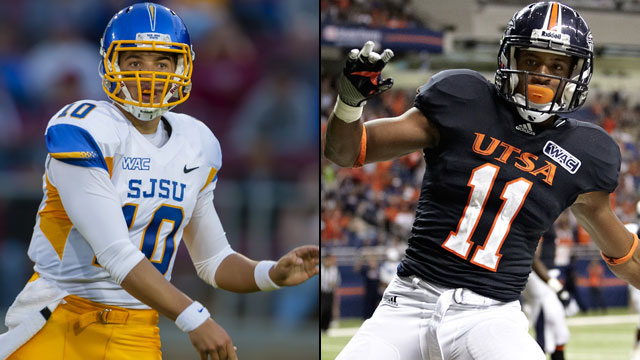 |
| San Jose State QB David Fales and UTSA RB David Glasco square off Saturday. |
I’ll be working the game with former Florida State offensive lineman Forrest Conoly, a familiar face by now, and we spent some time this week on the phone with both coaching staffs. There are a lot of matchups and sub-plots to keep an eye on, but here are the two biggest questions of the game:
Can San Jose State’s offense bounce back?
San Jose State was sacked 13 times last week. 13! That’s only two shy of the NCAA record. Nobody expects UTSA to duplicate that effort; the Roadrunners’ defensive front is nowhere near the equal of Utah State’s, and San Jose State will definitely make some adjustments. But UTSA is going to have to get pressure on Spartan quarterback David Fales, a junior college transfer with an almost unerringly accurate arm. If Fales is forced to move in the pocket, it could disrupt his throws enough to keep UTSA in the game. San Jose State will also try to take some pressure off Fales and his receivers by running the ball – after all, Rice ran for 301 yards against the Roadrunners last week – and the UTSA defense will likely need to continue producing turnovers to win the game.
Can UTSA win without a full-strength Eric Soza?
Roadrunners quarterback Eric Soza scored the first touchdown in program history, has started every game, and rarely misses a snap. Any discussion of team leaders starts with him. So when he jogged to the locker room with a hip injury late in the first half last week, it was a troublesome sign. He returned to play the second half and practiced this week, but he is still a question mark for Saturday and will not be at 100 percent even if he does play. It is asking a lot of UTSA, which is probably outmanned on pure talent, to win without him or with him at less than 100 percent. If he cannot go, redshirt freshman Ryan Polite should get the call; he looked good on two drives against Rice. How the possibly hampered Soza or the inexperienced Polite performs will be the first make-or-break challenge facing UTSA.
Players to watch
San Jose State
10 David Fales, QB 162-316, 1,867 yards, 12 TDs, 3 INTs
Coaches on both sides rave about his accuracy, capable of squeezing throws into tight spaces, and Fales has talented receivers to make it pay off. He struggled to get rid of the ball quickly, however, against Utah State's fearsome pass rush.
43 Travis Johnson, DE 39 tackles, 13.5 tackles for loss, 7.5 sacks
As consistent as they come, Johnson continues to get into opposing backfield despite facing regular double-teams. He's tied for the national lead with a tackle for loss in 12 consecutive games, and he is the only player from a non-BCS school to be one of 25 quarterfinalists for the Rotary Lombardi Award.
UTSA
1 Kam Jones, WR 12 receptions, 205 yards, 1 TD
Forrest always likes to ask about a 'wild guy,' and Jones is it. A former high school quarterback from small town Edna, Texas, Jones can catch, run, and throw from his wide receiver spot. He hasn't scored since the season opener, but he's the offensive playmaker.
17 Erik Brown, CB 16 tackles, 4 interceptions, 1 forced fumble in 5 games
Brown was a high school star at local power Converse Judson, but finished high school in Arizona and began his college career at Fresno State. Back home in Texas, he is responsible for five of UTSA's 17 forced turnovers and a key player in a secondary that faces a stiff test on Saturday.
Subscribe to:
Posts (Atom)