12 August 2013

My Salt Lake trip in photos

My trip to Salt Lake City to call Saturday's RSL-Houston game felt like a bit of a whirlwind -- mostly because I flew out on a red-eye the night after the game. But I managed to find time to snap a few photos of the Salt Lake City scenery and the pre-broadcast preparation. Here's a look:

View from the plane of the Great Salt Lake.

I walked by the Salt Lake City and County Building on Saturday morning.


I also happened by the Matheson Courthouse.


My first time entering Rio Tinto Stadium through the main entrance.


One of the league's most dramatic backdrops ...

... and the broadcast truck preparing to highlight those Wasatch Mountains.

With Sebastian and Eddie ... can't wear an orange tie EVERY game!


Almost ready for real kickoff ...
... but the show is already off and running.

05 August 2013

RSL-Houston thoughts: More late drama or another scoreless draw?

Jason Kreis is hoping to avoid a third consecutive
stoppage-time defeat against Houston.
I’m back on the MLS airwaves this weekend with a chance to step in for Glenn Davis and call Saturday’s Real Salt Lake-Houston game on Comcast Sportsnet Plus in Houston. I’m really excited for just about every aspect of this broadcast: working with Eddie Robinson and the Comcast crew, calling a game with the dramatic backdrop provided by Rio Tinto Stadium, and of course the matchup itself.

It’s not a rivalry game in the traditional sense (no geographic ties or playoff matchups), but I’ve been at nine of the last 10 games between these teams, and they’ve all been intense. The reason, to me, is a simple one: Even among MLS head coaches, who have to be competitive by nature, head coaches Dominic Kinnear and Jason Kreis stand out as two of the most intensely competitive personalities in American soccer. Their teams are skilled, but physical, and games between these two have always been closely contested – out of 16 head-to-head contests, 14 have been decided by one goal or less.

Here are some early thoughts on the game:

Despite Houston’s dominance in the all-time series (8-3-5 all-time, 6-1-4 since August 2007), Salt Lake has to be considered the favorite on Saturday. RSL is tied for the Supporters’ Shield lead (38 points from 23 games), leads the league in goals per game (1.65), and has the league’s goals against average leader in Nick Rimando (0.89). More importantly, the game is in Utah, where RSL has a 3-1-4 all-time edge. Three of the last four games between the teams in Utah have finished 0-0 (2008, 2009, 2011), and the other was a resounding RSL win. For an idea of Houston’s perspective, the 2009 game was the very rare instance I can recall of Kinnear playing for a draw almost from the start (started in a 4-5-1 formation with Kei Kamara at right midfield).

On the other hand, Salt Lake might be vulnerable at the moment. It will be RSL’s third game in eight days, and if media quotes are to be believed, Wednesday’s Open Cup semifinal against Portland is considered a higher priority. Salt Lake's last two home games have seen them collect just one point, with a player ejected each time. And after an 11-game unbeaten run in all competitions, RSL is winless in its last three games, including two gutting stoppage-time losses.

Hmm, stoppage-time losses. Sounds familiar. Houston has beaten Salt Lake in their last two head-to-head meetings on goals in the 93rd and 94th minutes, respectively. After last year's Colin Clark PK, Jason Kreis had that classic, stone-faced, I-can't-believe-that-just-happened look, and we saw it again when RSL lost to New York on Saturday. But both teams actually have a flair for the dramatic. In the final 15 minutes of games this year, RSL leads MLS with 15 goals scored, but has allowed 9 goals (+6 goal differential). Houston is second-best in MLS with only 3 goals allowed and has scored 10 of its own (+7 goal differential). So we could see some dramatics on Saturday night. After all, the last time I called a Houston-Real Salt Lake game, this happened:

22 July 2013

How Matthew Foerster got stoppage time correct in the RSL-KC game

I didn’t watch the Real Salt Lake-Sporting Kansas City game on Saturday night. But when I got ready to turn in for the night, my Twitter feed told me the game was still 1-1 in stoppage time, with RSL down a man, and I figured I’d check out the climax.

Sporting Kansas City had just enough time to score the winning goal.
What I got, of course, was one of the latest, most dramatic goals of the year, as Kansas City’s Ike Opara headed in a corner kick in the seventh minute of stoppage time to give Sporting the win. Much of the post-game controversy surrounded the referee, Matthew Foerster, including both his performance throughout the game and why 5 minutes of stoppage time had been announced, but 7 minutes and 20 seconds were played.

Having not watched the game, I cannot speak to Foerster’s performance in terms of fouls and cards. But having watched (and now re-watched, with a stopwatch) stoppage time, I can tell you his assessment of stoppage time was spot-on.

Stoppage time exists because the referee stops the game clock (either literally, via his watch, or mentally, by noting the time) at certain points during the game. These stoppages can be for injuries, goals, cards, substitutions, excessive time-wasting, and the like. Every game has stoppage time, so most of these are not unusual. The amount of stoppage time announced by the fourth official (in this case, a big ‘5’ was displayed to the stadium) is a minimum, and is announced as such in the stadium by the public address announcer.

So why were RSL and KC still playing in the eighth minute of stoppage time on Saturday? Because there were stoppages during stoppage time. By my calculation, in terms of actual playing time, Saturday’s game had 4 minutes and 58 seconds of stoppage time. Right on the money.

Here’s how I figured it:

In the 92nd minute, Real Salt Lake midfielder Javier Morales was fouled and fell to the ground. Shortly afterward, he grabbed his knee and rolled over. I stopped my watch at 91:14, when he first rolled over. The referee, Foerster, came over to Morales without blowing his whistle, so I can’t say for sure when he stopped the game clock, but I know that Foerster re-blew his whistle at 92:05, calling for the game to resume. That’s 51 seconds.

In the 96th minute on the television clock (about 94:24 on mine), Foerster breaks up a scuffle between players from both teams in the penalty area. He blows his whistle to stop play at 95:15 and restarts play at 95:58. That’s 43 seconds.

So while the game clock read 95:58, and Real Salt Lake fans were thinking the game should have been over a minute earlier, the amount of stoppage time played was well under five minutes. In fact, Graham Zusi struck the corner kick at 4:46 on my watch, and Opara’s header found the back of the net at 4:49.

I stopped my watch for another 45 seconds during the Kansas City celebration, although we cannot be sure for how long Foerster stopped his, which leads us to our final total of 7:17 on the television clock, but 4:59 on the actual clock.

So everyone is entitled to have their say about Foerster's decisions and game management, but I hope they will re-consider their criticism of the amount of stoppage time. Five minutes was announced, and five minutes was played.

Here’s a spreadsheet summarizing the stoppage time played:

Start timeEnd timeElapsed
90:0091:141:14
92:0595:153:10
95:5896:230:25
97:0897:170:09
4:58

11 July 2013

Breakfast of champions

A breakfast I would advise you try: banana pancakes. ... With ice cream on top. Seriously. What could be better? Maybe you could mix and match some flavors of both pancake and ice cream, but the general concept of ice cream on top of pancakes seems hard to beat.

That's right - that's ice cream, not butter, adorning this stack.

08 July 2013

Right place, right time to call spectacular Nagbe goal

I had a great chance to work with an up-and-coming organization in MLS, the Portland Timbers, on a game a few weeks back. This is a club that puts a lot of resources into its broadcasts and has already seen its television play-by-play broadcaster, John Strong, hired as the new (American!) voice of MLS on NBC Sports.

Booth shot in Frisco.
So when the Timbers asked me if I was available to provide the radio call for their Lamar Hunt U.S. Open Cup quarterfinal against FC Dallas on June 26 (I'm only a 3-hour drive away), I was psyched to do it.

It had been about 20 months since I had done radio play-by-play, so I felt a little rusty at times, but the game had a terrific second half and one wonderful goal, and it was a really fun experience from start to finish. I'm hoping to produce more extended highlights at some point, but here are the calls from the Timbers' big plays, including Darlington Nagbe's spectacular solo effort:


As an added bonus, I've been called on by Comcast Houston to do play-by-play for the Houston Dynamo's August 10 game against Real Salt Lake. Can't get enough MLS action!

01 July 2013

Fun with news typos

This was up on CBSNews.com (and Google News' top result) for at least 30 minutes on Monday afternoon, despite my best efforts (in red) to fix it:


I have made my share of typos -- I once sent out a press release with "El Pason" in the subject line instead of "El Paso" -- but when a typo like this appears in headline, lede, and page header (not pictured), and nobody at a major news site catches it for 30 minutes, it's kind of jaw-dropping.

EDIT: After about 30 minutes online, the offending typos have been fixed. Of course, the URL remains "lightening," but I suppose correcting a permalink would have been too much to ask:
http://www.cbsnews.com/8301-201_162-57591811/lightening-sparked-deadly-arizona-fire/

19 June 2013

Baseball highlights with my voice? It's been far too long ...

It's been seven years since I called baseball games on any kind of regular basis - long live the 2006 United League champion Alexandria Aces! - but I jumped back into a brief bit of regular work when I called the Western Athletic Conference baseball tournament for the WAC website last month.

I had a blast! It was so great to go to the ballpark for a game every day (three games per day, in fact, and 3.5 on Saturday) and be able to feel myself getting back into the rhythm of things as the tournament went on. Don't get me wrong, I love working other sports, too, but the every-day nature of baseball makes it different. Not better or worse, but different, and I had missed it.

I would like to work some baseball games in the future, of course, so I'm currently working on a new baseball demo reel, which I should finish by the end of the week. In the mean time, however, I put together a highlight video with some of the best plays (and calls) from the tournament. Check it out here:


Looking back on the tournament, I got to see a bunch of really rare baseball plays, all packed into one tournament. Check these out:
  • TRIPLE PLAY - turned by CSU Bakersfield against San Jose State in Game 2. (Unfortunately, this occurred during a technical glitch, so no recording exists. A long-term lament of mine.)
  • DOUBLE STEAL OF 2ND/HOME - pulled off by UTSA in Sunday's championship game against Dallas Baptist.
  • TWO RUNS SCORE ON WILD PITCH - (with the caveat that there was a throwing error mixed in), when New Mexico State ran the bases aggressively in Game 8.
  • WALK-OFF HOME RUN - provided by UTSA's R.J. Perucki in the tournament opener against Sacramento State.
  • 14-INNING GAME - the longest I have ever called, also in the tournament opener.
  • INSIDE-THE-PARK HOME RUN - pulled off by Texas State's Kevin Sah in Game 12 against UT-Arlington.
  • BASEBALL STUCK IN CATCHER'S MASK - (breaking the catcher's nose in the process), which happened to the incredibly unfortunate Cael Brockmeyer from CSU Bakersfield in the Saturday-morning resumption of Game 9.
There were plenty of normal big plays - home runs, double plays, big strikeouts, and plays at the plate - but every one of the above plays is something totally out of the ordinary. I've gone entire minor-league seasons without seeing any of those happen, and I got to call all of them in five days last month. Not too shabby.

07 June 2013

On the job again, in a new role

CSN Houston broadcast team in tight quarters in Columbus:
from left to right: Sebastian Salazar, Glenn Davis, me.
I got to work on back-to-back weekends recently, as I was fortunate enough to fill in for Eddie Robinson as the color analyst on the CSN Houston broadcast of the Houston Dynamo's game against the Columbus Crew last Saturday.

Having covered Major League Soccer regularly since 2007 and followed it closely since 2001, I had no trouble getting familiar with both teams. But my role - that of color analyst - is one I have rarely filled in the past. My only other outing as an analyst came with a play-by-play man who did not know soccer, so my role was mostly to fill in the details. That came in stark contrast to Saturday's game, as my play-by-play partner, Glenn Davis, is one of the most respected soccer broadcasters in the country and has plenty of experience in both play-by-play and color roles. In fact, the only previous time that Glenn and I worked a game together, the 2011 MLS Cup final, our roles were reversed.

The Preparation

I know how the analyst's role works, of course, but I still wanted some advice on how to keep my analysis succinct and useful, how to watch the game, and generally how to be effective. So I made phone calls to Brian Dunseth, a colleague and friend who calls games for just about everybody in American soccer, and a less familiar acquaintance, NBC Sports analyst Kyle Martino. I also talked with Glenn on the day of the game to ask his advice.

They all gave different answers, of course, which was interesting in its own right, but here are four of the keys I used - or tried to use - in approaching Saturday's assignment:
  • Know your role.
    Obvious, but important: when to talk and what to say. As the analyst, it was not my job to provide the basic information of score, minute, subs, player background. Analysts also need to lay out - or get out, if they're in the middle of talking - when the ball reaches the final third of the field. For me specifically, however, it also meant trying to avoid over-reaching. I'm not a former player and cannot provide that exact perspective. My strength is my knowledge of the league, its teams, and their history, so I tried to put things in context, like pointing out that the Crew's only wins came against the three worst teams in the league, and keep historical trends in mind, such as five of the teams' last eight meetings ending in a tie.
  • Get your rhythm.
    Both Dunseth and Martino stressed finding a rhythm with your play-by-play announcer. The pacing of the back-and-forth is very important, as you don't want to step on each other or detract from what the other is saying. I tried to play it safe in the early going, only chiming in when I was sure it was the right time, but I grew more confident as the game went on, and I think Glenn and I worked out a good understanding.
  • Keep the big picture in mind.
    Another point that appeared consistently, though with several meanings. This can mean analyzing a play in the context of the season or a player's development (i.e. "This run by Sarkodie is exactly what the Dynamo were hoping to see when they drafted him, and they're starting to see it more often as he matures") or it can mean looking behind the play, off-camera, for the positioning of the back line as its team moves into attack. Given the luxury of being in the building for an away game, rather than calling it from a studio, the broadcasters need to take advantage of being able to see everything that's going on. This was helpful throughout, especially being able to spot how the Houston bench was reacting to on-field injuries and which players were warming up to come in.
  • Answers the questions, "Why?" and "How?"
    This might be the most important perspective to maintain as an analyst. All three guys that I talked to used some form of this as some of their main advice. Rather than only narrating the replay, try to answer those questions: Why did the play happen the way it did? How does this affect the team, the game, or the season?
    I'm not entirely sure if I kept my head enough to pull this off on a consistent basis or not. Once I get to watch the tape, I'll have a better idea, but this is certainly one of the areas in which I need the most work if and when I get to work another game as analyst.
A couple of other suggestions I heard in discussing the role of analyst: keep constant eye on the shape of the back four, try to break the game into short segments to assess which team is playing better, don't get stuck talking only about what's on-screen, and always ask, "Am I adding to or distracting from the game?"
Highlighter-themed uniform night?

The Game

So those were some of the things I was trying to do. On the whole, I felt the broadcast went pretty well. As I mentioned, I got a lot more comfortable and confident as the game went on. There may have been a couple of slight, "Who, ME?" moments before I remembered it was my job to talk through the replays!

I realized afterward that I missed a great chance to reference a stat I had written down: Kofi Sarkodie had three assists in his first six games but had not recorded one in seven games since. On Saturday, he made a terrific run down the right and cross to Warren Creavalle for the opening goal, but I was so caught up in how cool the goal was - really a classy move all the way around - that it slipped my mind. Definitely an opportunity missed.

Working on the broadcast also meant being part of a 30-minute pre-game show and 30-minute post-game show, which you don't find on many MLS broadcasts. The pre-game show turned out to be a lot of fun. We had a meeting about it Saturday morning, and I got a great rundown from our producer, Kevin Cedergren. It was my first time working with CSN's Sebastian Salazar, who flew in on the day of the game after watching Mexico-Nigeria the night before, and I think Sebastian, Glenn, and I got into a pretty good rhythm right away. We tried to have fun with the pre-game show - I think I interrupted both of them to suggest a "road trip!" to the Open Cup game against Dallas - and it actually went pretty quickly. Unfortunately, there were some technical issues that meant it was not widely seen in Houston, so that was frustrating to find out after the fact.

One of the highlights of the day was seeing former Dynamo president Oliver Luck, somebody who's been very helpful in my career, as he stopped by after making the two-hour drive from his current job as athletic director at West Virginia University. His son, Andrew (you may have heard of him) said hello as well, so I assume the Crew fans in front of us were gawking more at Andrew than at Oliver, Glenn, or me. Andrew has always been a class act in my limited interactions with him, but I will admit to being a little surprised when I discovered that he is the rare 21st-century athlete who is NOT on Twitter.

So it was a great night to be calling an MLS game again, and I definitely enjoyed my different role and working with Glenn, Sebastian, and the CSN team. I wouldn't mind doing it again some time, but hopefully without all the injuries that we saw in the game!

27 May 2013

Lasting images from this weekend's WAC tournament

The broadcast setup w/ digital notes, generously loaned
headset, scorebook, water, hard-copy notes.
Hard at work.
I'm pretty exhausted after calling 13 baseball games in five days, but it's a good feeling. I really enjoyed researching all the teams and then seeing them in action, and the Western Athletic Conference staff did a great job of welcoming me for the week.

I hope to get some highlights (with video) and a demo reel put together in the next few weeks to look back at the tournament and my latest return to the baseball airwaves, but some cell-phone photos are going to have to do for now:


Some guy with a sore throat.
Official baseball of the 2013 WAC championship! and a
scorebook page ready for championship-game lineups.


More than 30 scouts were on hand to watch
Dallas Baptist's Jake Johansen throw 98-101 mph.
Front entrance of QuikTrip Park.


We played until 10 or 11 p.m. on more than one occasion,
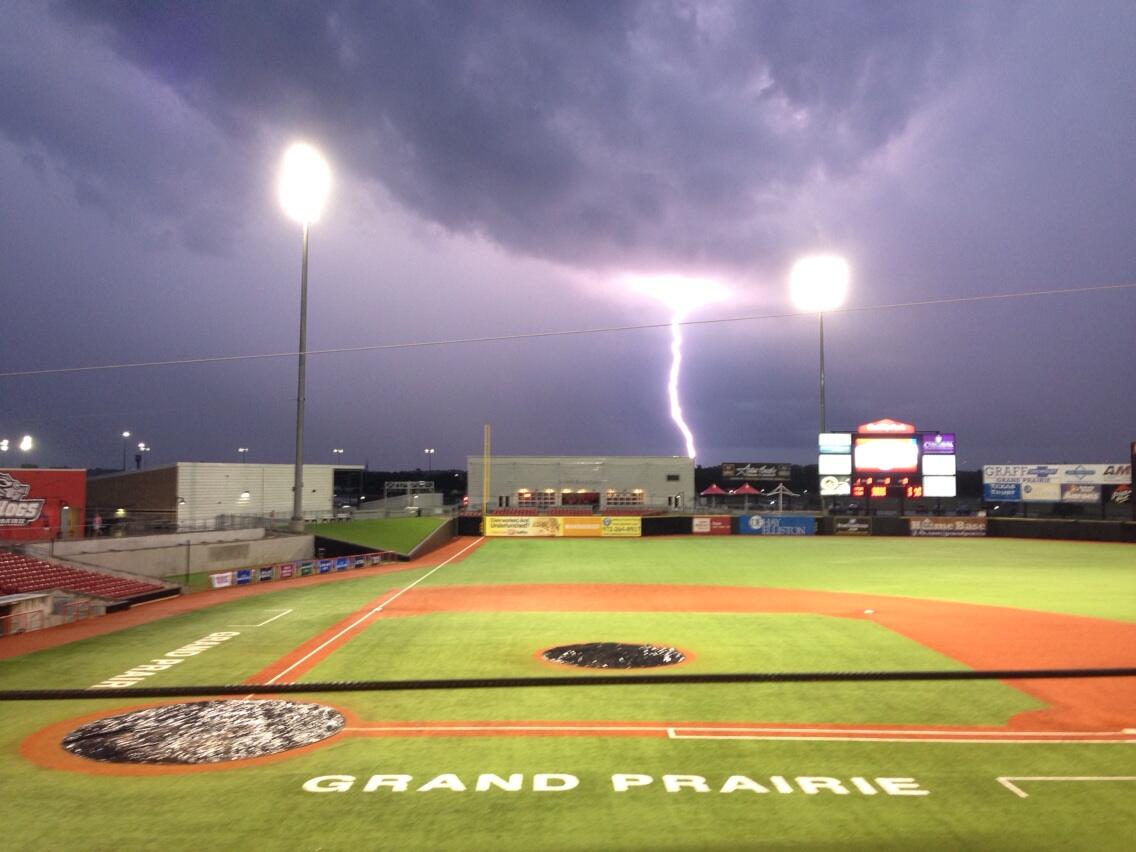
particularly due to some lightning delays.
It may be an artificial turf field, but preparing it
(and maintaining it) still takes some work!


25 May 2013

Why Friday night game was delayed

'Borrowed' from Twitter.

Um yeah, good decision. It's tough on both teams (UTSA, CSU Bakersfield) to have to get up, mentally, for such a big game the next morning, and it's terrible to affect both teams' starting pitchers, but Friday night's game had to be delayed. It will resume Saturday morning at 10 a.m. CT.